Computer-Assisted vs Robotic Knee Replacement India β€” Shivaan Hospital Surat
Knee Replacement Technology Guide Β· Surat 2026

Computer-Assisted vs. Robotic Knee Replacement in India: What's the Real Difference β€” and Which Should You Choose?

Jigneshbhai, a 62-year-old businessman from Surat, was advised to have "robotic surgery" at a Mumbai hospital. The cost was nearly double local options. He assumed that without the robot, he would be getting inferior care.

What nobody told him was that Shivaan Hospital in Surat offers Arthro 3D computer-assisted navigation β€” a precision technology that delivers alignment accuracy comparable to robotic systems, at a fraction of the cost, without leaving his city.

This guide cuts through every marketing claim so you can make a genuinely informed decision.
πŸ“ Shivaan Hospital, Surat 🩺 Dr. Krunal Donda β€” Arthro 3D Navigation ⏱ 9 min read
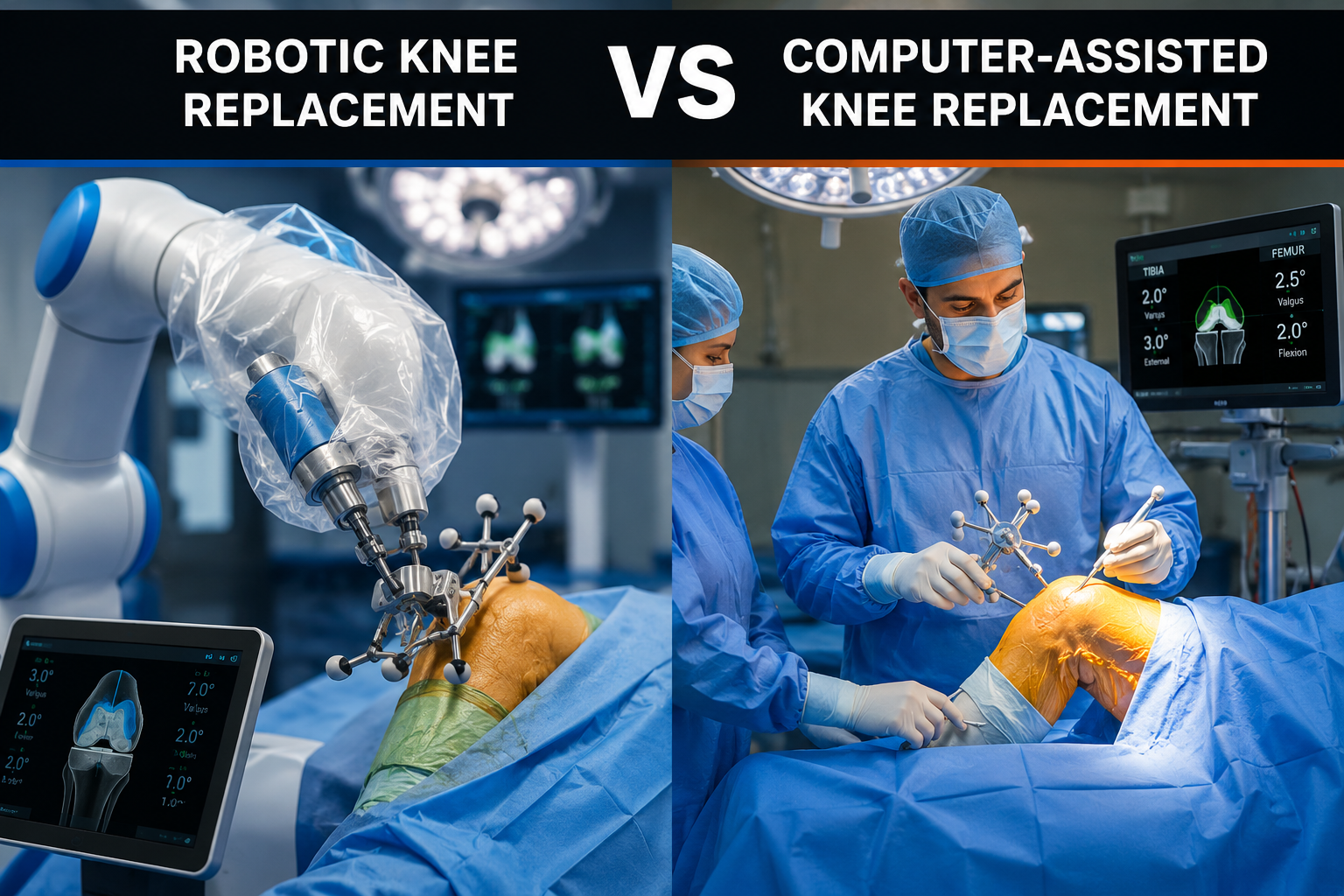
Comparison of computer-assisted and robotic knee replacement technologies showing precision alignment, surgical guidance, and treatment options in Surat
Know your options

The 3 Types of Knee Replacement β€” Explained Simply

Hospitals use "robotic", "computer-assisted", "navigation", and "smart knee replacement" interchangeably β€” but they describe fundamentally different technologies with different costs, evidence bases, and availability across India. For more details on knee pain treatment and total knee replacement surgery in Surat, consult our specialists.

1
Traditional
Conventional Knee Replacement
Surgeon uses mechanical alignment jigs and tactile skill. Excellent outcomes in expert hands. Still the most widely performed method globally. Outcome highly dependent on surgeon experience.
2
Available in Surat
Computer-Assisted Surgery (CAS / Navigation)
Real-time digital guidance gives the surgeon live feedback on bone cuts, implant position, and leg alignment during surgery. No robotic arm. No pre-op CT scan required. 20-year evidence base.
3
Metro Hospitals Only
Robotic-Assisted Surgery
A robotic arm physically constrains the cutting tool within pre-planned boundaries. Requires a dedicated pre-op CT scan. Significantly higher cost. Currently limited to large corporate hospitals in Mumbai, Delhi, Bengaluru.
Side by side

How Each Technology Works During Surgery

Understanding the mechanics of each system helps you ask the right questions β€” and evaluate what your hospital is actually offering.

Computer-Assisted Surgery
CAS / Navigation (Arthro 3D)
Infrared sensor arrays track bone and instrument position in 3D throughout the procedure
Navigation screen shows the surgeon live alignment data β€” bone cuts, axis, and implant position in real time
No robotic arm β€” surgeon performs all cuts; technology provides continuous guidance and confirmation
No pre-operative CT scan required β€” geometry mapped intraoperatively in minutes
Any deviation from the plan is flagged before the cut is made, allowing immediate correction
15–20 years of peer-reviewed outcome data across thousands of published cases
Robotic-Assisted Surgery
Mako / NAVIO / ROSA Systems
CT scan before surgery creates a 3D model of the patient's specific bone anatomy, uploaded to the robotic system
During surgery, a robotic arm physically constrains or assists the cutting tool within pre-planned boundaries
The robot does not operate independently β€” the surgeon controls all movements through the robotic interface
Pre-operative CT adds radiation, cost, and a separate appointment to the process
Marginally tighter precision tolerance (Β±0.5Β°) vs. CAS (Β±1–2Β°) in ideal conditions
5–10 years of comparative data; long-term equivalence to CAS still being established in literature
Feature by feature

Head-to-Head: Computer-Assisted vs. Robotic Knee Replacement

Every meaningful clinical and practical difference between CAS navigation and robotic surgery β€” so you can ask informed questions at your consultation:

Feature Computer-Assisted (CAS / Arthro 3D) Shivaan Hospital Robotic Surgery (Mako / NAVIO) Metro Only
How it guides the surgeon Real-time digital navigation screen β€” live feedback on every cut Robotic arm physically constrains cutting tool within planned zone
Pre-op CT scan needed? No β€” geometry mapped intraoperatively Cost Saving Yes β€” dedicated CT scan before surgery required
Alignment precision Within Β±1–2Β° of planned axis in published studies Within Β±0.5–1Β° in ideal conditions
Cost to patient in India Moderate addition over conventional surgery Value Significantly higher β€” system, CT scan, consumables all added
Available in Surat? Yes β€” Shivaan Hospital, Dr. Krunal Donda Local No β€” currently Mumbai, Delhi, Bengaluru only
Long-term outcome evidence 15–20 years of peer-reviewed data 5–10 years comparative data β€” still accumulating
Surgeon experience impact High β€” surgeon skill remains the primary outcome variable Moderate β€” robotic system assists but cannot replace judgement
Best suited for All primary TKR; complex deformity; value-conscious patients Patients in metros seeking premium technology marketing
πŸ“Š The Evidence-Based Bottom Line
Published long-term studies comparing implant survivorship show no statistically significant difference between well-performed CAS navigation and robotic-assisted TKR. The most important variable in every study is surgeon fellowship training and experience β€” not the technology used. A fellowship-trained surgeon using Arthro 3D navigation is a clinically excellent and far more accessible choice for the vast majority of Indian patients.
Shivaan Hospital Technology
Arthro 3D at Shivaan Hospital: What Surat Patients Actually Get

Dr. Krunal Donda uses the Arthro 3D computer-assisted planning and navigation system β€” delivering precision outcomes without the cost and complexity of robotic surgery. Here is exactly what this means for your operation:

Pre-Operative 3D Planning
Using existing X-rays, Arthro 3D creates a digital knee model. Implant size, position, and alignment are planned and finalised before the operating theatre β€” not improvised during surgery.
Real-Time Intraoperative Navigation
Live sensor feedback confirms every bone cut is within target parameters before it is made β€” not after. Any deviation is corrected in real time, not discovered post-operatively.
Soft Tissue Balancing Guidance
Beyond bone cuts, Arthro 3D guides ligament and capsule tension assessment through the full range of motion β€” ensuring the implant feels natural and stable in both flexion and full extension.
No Additional CT Scan Required
Unlike robotic systems, Arthro 3D maps the knee geometry intraoperatively. No additional radiation, no separate pre-op appointment, and no CT scan cost added to your package.
Clear the misconceptions

4 Myths Patients Believe About Knee Replacement Technology

Marketing language around surgical technology creates persistent myths that affect patient decisions β€” and sometimes lead to paying significantly more for no clinical benefit:

βœ• Myth 1
A robot performs the operation independently
βœ“ Reality
No robotic system operates autonomously. The surgeon controls all movements. The robot provides a physical boundary β€” the surgeon's judgement, training, and technique remain the primary determinants of your outcome.
βœ• Myth 2
Computer-assisted surgery is inferior to robotic surgery
βœ“ Reality
Long-term outcome studies (10–20 years) comparing implant survivorship show no statistically significant difference between well-performed CAS navigation and robotic TKR. The most important variable is surgeon experience with the system.
βœ• Myth 3
Hospitals without a robot cannot offer precision surgery
βœ“ Reality
Computer-assisted navigation systems like Arthro 3D deliver precision far exceeding conventional surgery and within the same clinical accuracy range as most robotic platforms. Robotic surgery is not a prerequisite for excellent alignment outcomes.
βœ• Myth 4
Robotic knee replacements last significantly longer
βœ“ Reality
No robotic system has demonstrated superior long-term implant survivorship over well-aligned CAS-guided TKR in peer-reviewed studies with 10+ year follow-up. Longevity depends on alignment accuracy, implant quality, patient weight, activity, and rehabilitation.
Find your fit

Which Technology Is Right for Which Patient?

The right technology depends on your diagnosis, anatomy, activity level, and practical circumstances. Here is a clear breakdown:

Patient TypeRecommended TechnologyWhy
Standard primary TKR β€” most patients CAS Navigation (Arthro 3D) 20-year evidence base; excellent alignment; lower cost; available in Surat without travel
Complex deformity (severe varus / valgus) CAS Navigation (preferred) Real-time soft tissue and alignment feedback is most valuable when anatomy is complex
Younger patient (under 60), highly active CAS or Robotic Precision alignment reduces wear rate in active patients; both technologies appropriate
Revision TKR (previous failed surgery) Surgeon expertise first Fellowship training in revision surgery outweighs technology choice in complex reconstruction
Patient prioritising cost efficiency CAS Navigation Equivalent clinical outcomes at substantially lower cost than robotic surgery
Patient with access only to large metro hospitals Robotic if preferred and affordable Robotic systems currently concentrated in metro hospitals only β€” CAS available in Surat
Why Surat patients choose Shivaan

Why Choose Shivaan Hospital for Computer-Assisted Knee Replacement?

Β±1–2Β°
Arthro 3D alignment accuracy β€” comparable to robotic systems
20yr
Published evidence base for CAS navigation outcomes
0
Pre-operative CT scans required for Arthro 3D navigation
German Fellowship β€” Europe's Leading Arthroplasty Centre
Dr. Donda trained at BrΓΌderkrankenhaus St. Josef, Paderborn β€” where Arthro 3D precision planning and CAS navigation are the standard of care for every TKR.
Arthro 3D Navigation β€” Precision Without the Robotic Price Tag
Real-time 3D alignment guidance delivers outcomes equivalent to metro robotic surgery at a fraction of the cost β€” available in Surat without travel, waiting lists, or compromised care.
Transparent Written Cost Estimate Before Any Commitment
Every patient receives a written package breakdown including navigation, implant brand, anaesthesia, physiotherapy, and follow-up β€” no hidden charges, no surprises on discharge.
Complex and Revision TKR Expertise
Patients from across Gujarat are referred to Dr. Donda for failed implants, complex deformity cases, and revision knee replacement β€” the most technically demanding procedures in arthroplasty.
Be an informed patient

6 Questions to Ask Your Surgeon Before Knee Replacement

A confident, fellowship-trained surgeon welcomes every one of these questions. If a surgeon cannot answer them clearly, that is important information:

Q1Which guidance system will you use for my surgery β€” conventional, CAS navigation, or robotic? And why is it the right choice for my specific anatomy?
Q2What is your personal audited alignment accuracy data using this system? How many cases have you performed with it?
Q3What implant brand and bearing type is included in my package? Is there an option to upgrade the bearing surface?
Q4Will I need a pre-operative CT scan for this system, and is that cost included in the package?
Q5What is your revision rate for knee replacement surgery, and what happens if I need revision surgery in the future?
Q6Is there a written package cost that specifies everything included β€” navigation, implant, anaesthesia, physiotherapy, and first follow-up?
Patient questions answered

Frequently Asked Questions

The most common questions from patients comparing technology options for knee replacement surgery in India.

Is robotic knee replacement better than computer-assisted?
Not definitively. Published studies show equivalent long-term implant survivorship between CAS navigation and robotic surgery when performed by experienced surgeons. Robotic systems offer marginally tighter precision in ideal conditions β€” but the clinical difference in outcomes for most patients is not yet established in long-term literature.
Does Shivaan Hospital offer computer-assisted knee replacement?
Yes. Dr. Krunal Donda uses the Arthro 3D computer-assisted surgical planning and navigation system for knee replacement at Shivaan Hospital, Surat. This provides real-time intraoperative precision guidance without the additional cost of a robotic system.
Does computer-assisted surgery need a CT scan before the operation?
No β€” most CAS navigation systems including Arthro 3D use intraoperative data points to map the knee in real time, without a separate pre-operative CT scan. Robotic systems like Mako require a pre-op CT scan to build their planning model, adding cost and radiation.
How much more expensive is robotic knee replacement?
In India, robotic TKR typically adds β‚Ή60,000–₹1,50,000 to the total procedure cost compared to CAS navigation β€” reflecting the robotic system, CT scan, and per-case consumable costs. This varies by hospital and city.
Can I get precision knee replacement in Surat without going to Mumbai?
Yes. Arthro 3D computer-assisted navigation surgery is available at Shivaan Hospital, Surat under Dr. Donda. Patients achieve precision outcomes equivalent to metro robotic surgery without travel costs, logistical complications, or being far from family during recovery.
Does CAS surgery make the knee replacement last longer?
Proper alignment is one of the strongest predictors of implant longevity. Malaligned implants wear unevenly and fail earlier. CAS navigation significantly improves alignment accuracy over conventional surgery β€” which directly benefits long-term implant survival.
Is Arthro 3D the same as robotic surgery?
No. Arthro 3D is a computer-assisted navigation and 3D planning system β€” it guides the surgeon with real-time digital feedback but does not involve a robotic arm. It delivers alignment outcomes comparable to most robotic platforms currently available in India.
What is recovery like after computer-assisted knee replacement?
Recovery time is the same as conventional TKR. Most patients walk on Day 1 using Dr. Donda's rapid-recovery protocol and are discharged within 2–4 days. Navigation technology does not extend surgery time or alter the rehabilitation pathway.
Should I travel to Mumbai for robotic surgery or stay in Surat?
For most primary TKR patients, CAS navigation surgery in Surat with a fellowship-trained surgeon delivers equivalent clinical outcomes to robotic surgery in Mumbai β€” at lower total cost, without travel, and with family nearby during recovery. This is worth discussing directly at a consultation.
How do I book a consultation at Shivaan Hospital?
Call or WhatsApp +91 98790-99184, visit Shivaan Hospital at Infinity Tower, Lal Darwaja Station Road, Surat, or book online at shivaanhospital.com. Bring X-rays and any previous specialist reports. Same-day appointments often available.
Book your consultation

Precision Knee Replacement Is Available in Surat β€” Without the Robotic Price Tag.

Book a consultation with Dr. Krunal Donda at Shivaan Hospital. Review your X-rays together, understand your technology options clearly, and receive a transparent written cost estimate β€” before making any decision.

Call / WhatsApp
+91 98790-99184

Leave a Comment

Your email address will not be published. Required fields are marked *

Scroll to Top