Total Hip Replacement vs Hip Resurfacing India — Shivaan Hospital Surat
Hip Surgery Decision Guide · Surat 2026

Total Hip Replacement vs. Hip Resurfacing: Which Procedure Is Best for Active Patients?

THR
Any age · 90%+ survival at 20 yrs
Hip Resurfacing
Under 60 · Full sport return
Mehulbhai, 52, a chartered accountant from Surat plays doubles tennis three times a week and completed a 10-kilometre run last year. When his surgeon told him he needed a hip replacement, his first question wasn't "which hospital?" — it was "will I ever play tennis again?"

His surgeon mentioned hip resurfacing but said very few specialists in Gujarat perform it. He was left wondering whether he was settling for second best. This guide explains both procedures, who is the right candidate, and what the evidence actually shows.
📍 Shivaan Hospital, Surat 🩺 Dr. Krunal Donda — THR & Hip Resurfacing ⏱ 8 min read
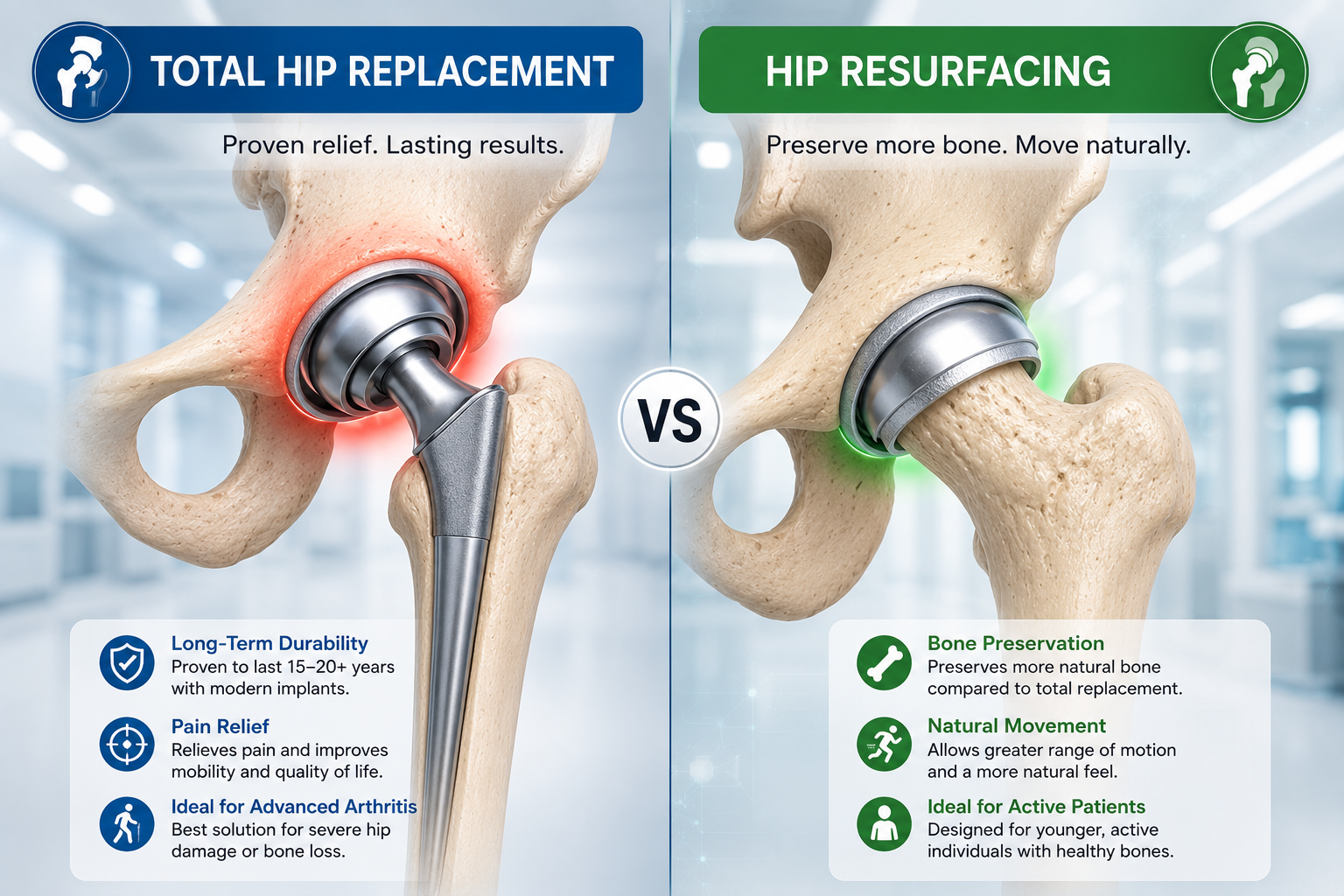
Comparison of total hip replacement and hip resurfacing procedures for active patients with hip arthritis and avascular necrosis in India
Understand both procedures

What Each Procedure Actually Involves

Both procedures eliminate hip joint pain and restore function — but through fundamentally different surgical approaches with different implications for bone preservation, stability, and post-operative activity level.

The Gold Standard
Total Hip Replacement (THR)
20-yr survival90–95%
Eligible ageAny age
WalkingDay 1
BearingCeramic / Poly
1
Damaged femoral head is removed completely
2
Metal stem inserted into the femoral canal (thigh bone)
3
New ceramic or metal ball attached to the top of the stem
4
Acetabular socket replaced with metal cup and ceramic / polyethylene liner
5
A minimally invasive muscle-sparing approach at Shivaan Hospital — faster recovery, less blood loss
Bone-Preserving Alternative
Hip Resurfacing (BHR)
15-yr survival (men)97%+
Ideal ageUnder 60
WalkingDay 1
SportFull return
1
Femoral head is reshaped — not removed — all neck and shaft bone preserved
2
A metal cap is cemented over the reshaped femoral head
3
Acetabular socket replaced with a matching large-diameter metal cup (>44 mm)
4
Large head provides exceptional stability — near-zero dislocation risk vs. 1–3% for standard THR
5
If revision is needed: preserved bone stock makes conversion to THR straightforward
Feature by feature

THR vs. Hip Resurfacing: Full Clinical Comparison

Every meaningful clinical and practical difference between both procedures — including where hip resurfacing holds a clear advantage for the right patient:

Feature
Total Hip Replacement (THR)
Hip Resurfacing (BHR)
Bone preservation
Femoral head removed; stem inserted into canal
Femoral head capped — shaft and neck fully preserved Advantage
Femoral head size
Smaller conventional size (28–36 mm)
Large diameter (>44 mm) — mirrors natural anatomy Advantage
Dislocation risk
1–3% — precautions required in early recovery
Under 0.5% — large head provides inherent stability Advantage
Return to sport
Low-impact sport; running discouraged long-term
Running, tennis, skiing, gym fully cleared in most patients Advantage
Best candidate age
Any age — especially 60+ or lower-activity patients Broader
Under 60; male; good bone quality; no osteoporosis
Revision if needed
Complex — stem removal; bone loss risk
Easier — preserved bone makes THR conversion straightforward Advantage
Gender suitability
All genders equally Universal
Male patients strongly preferred — ALVAL metal risk in women
Evidence base
15–20+ yrs; 90–95% survival Established
25 yrs for BHR; 97%+ survival in male candidates
Available in Surat
All orthopaedic hospitals
Shivaan Hospital — one of very few in South Gujarat Local
⚠ Metal-on-Metal Bearing — Women Must Know This
Hip resurfacing uses a metal-on-metal (MoM) bearing. While the BHR system has a 25-year track record, MoM bearings carry a significantly higher risk of adverse local tissue reaction (ALVAL) in women — particularly pre-menopausal women. Women with hip disease should receive THR with a modern ceramic or ceramic-polyethylene bearing. Hip resurfacing is recommended primarily for male patients in current international orthopaedic guidelines.
Find your procedure

Which Procedure Is Right for You?

The most important factor is not patient preference — it is anatomy, bone quality, gender, and activity goals. Here is how Dr. Donda makes the clinical decision at your consultation:

Age 65+ or lower-activity patient
Total Hip Replacement
Under 60, male, high activity level, good bone quality
Hip Resurfacing (BHR)
Female patient — any age
THR strongly preferred
Significant osteoporosis confirmed on DEXA scan
Total Hip Replacement
Avascular necrosis (AVN) of the femoral head
THR (usually)
Active male athlete wanting return to running / sport
Hip Resurfacing if candidate
Hip dysplasia with significant anatomical deformity
THR — resurfacing too complex
Previous resurfacing requiring revision
Conversion to THR
Life after surgery

What Can You Actually Do After Each Procedure?

The differences are clinically significant — particularly for patients wanting to return to running or high-impact sport. Select a procedure to see its post-operative activity profile:

Walking — assisted on Day 1 post-surgery
Swimming and cycling within 8–12 weeks
Golf and doubles tennis within 4–6 months
Light gym work and unlimited walking long-term
Running and high-impact sport — generally discouraged long-term to protect implant longevity
Running increases implant wear rates in standard THR. Most patients are advised to avoid sustained running to maximise implant survival beyond 20 years.
Walking — assisted on Day 1 post-surgery
Cycling and swimming within 8–10 weeks
Running, tennis, squash, skiing cleared from 4–6 months
Full gym work including weights — cleared in most patients
No permanent high-impact activity restrictions for most well-selected patients
Return to pre-surgery sport level achieved by the majority of well-selected male resurfacing patients — the defining advantage over conventional THR for active patients.
How the decision is made

The 3 Questions That Determine Your Best Option

At your consultation, Dr. Donda assesses these three factors to determine candidacy for both procedures and provides written recommendations with clinical reasoning before any surgical commitment:

1
What is your bone quality and femoral head size?
Hip resurfacing requires good bone density — no significant osteoporosis — and a femoral head large enough to accept the resurfacing cap. A DEXA bone density scan and MRI at Shivaan Hospital confirm whether your bone quality supports resurfacing before any surgical decision is made.
2
Are you male or female?
Due to the significantly higher ALVAL risk from metal-on-metal bearings in women — particularly pre-menopausal women — hip resurfacing is strongly recommended only for male patients in current international orthopaedic guidelines. Female patients should receive THR with a ceramic or ceramic-polyethylene bearing for maximum safety and longevity.
3
What are your specific activity goals after surgery?
Patients wanting to return to running, contact sport, skiing, or high-impact gym work are better served by hip resurfacing if they are candidates. Patients whose primary goal is pain-free daily function — walking, stairs, light exercise — are excellently served by modern minimally invasive THR with the same rapid-recovery protocol at Shivaan Hospital.
Why Surat patients choose Shivaan

Why Choose Dr. Krunal Donda at Shivaan Hospital for Hip Surgery?

Both
Procedures offered by the same fellowship-trained surgeon — THR and BHR
MIS
Minimally invasive muscle-sparing approach for THR — faster recovery
Surat
No travel to Mumbai — hip resurfacing expertise available locally in South Gujarat
German Fellowship — Brüderkrankenhaus St. Josef, Paderborn
Dr. Donda trained at one of Europe's highest-volume arthroplasty centres, where both THR and hip resurfacing are performed to European fellowship standards for every patient — not just selected cases.
One of Very Few BHR Surgeons in South Gujarat
Most orthopaedic surgeons in Surat offer only THR. Dr. Donda is among a small group in the region who performs hip resurfacing — giving patients a genuine clinical choice based on evidence rather than limited availability.
On-Site DEXA and MRI for Complete Candidacy Assessment
Bone density scanning and MRI at Shivaan Hospital confirm resurfacing candidacy — or rule it out clearly — before any surgical decision. Both options are assessed fully at a single first appointment with no additional visits required.
Written Comparison of Both Options — No Pressure Decisions
Every patient receives a written comparison of both THR and hip resurfacing — including risks, benefits, cost estimates, and recovery timelines — before any financial or surgical commitment is required.
Minimally Invasive THR — Rapid Recovery Protocol
Dr. Donda's muscle-sparing MIS approach reduces blood loss, intraoperative trauma, and recovery time. Most patients walk on Day 1 and are discharged within 2–4 days — whether they have THR or hip resurfacing.
When to act

Signs You Should Consult a Hip Specialist Without Further Delay

Earlier assessment means more procedure options — including joint-preserving approaches that become unavailable as disease progresses:

Hip or groin pain consistently affecting your ability to walk, exercise, or sleep
Hip stiffness that prevents you from putting on shoes or socks independently
An MRI or X-ray showing advanced hip arthritis, AVN, or significant cartilage loss
You are under 60 and told you need a hip replacement — resurfacing candidacy must be assessed before committing to THR
You are an active male under 55 who wants to return to running or high-impact sport after hip surgery — read our guide on hip pain in young adults
You have had a previous hip procedure that is now causing recurrent or new pain
Patient questions answered

Frequently Asked Questions

The most common questions from patients comparing total hip replacement and hip resurfacing in India.

Can I run after hip resurfacing?
Yes — most well-selected male hip resurfacing patients are cleared for running between 4–6 months post-surgery. Running is generally not recommended long-term after conventional THR due to higher wear rates on standard femoral heads — making resurfacing the preferred choice for active runners who are candidates.
Is hip resurfacing available in Surat?
Yes. Hip resurfacing is performed by Dr. Krunal Donda at Shivaan Hospital, Surat — one of very few fellowship-trained surgeons offering this procedure in South Gujarat. Candidacy assessment for both THR and resurfacing is completed at your initial consultation, with no additional appointments needed.
Why is hip resurfacing not recommended for women?
Metal-on-metal bearings carry a significantly higher risk of adverse local tissue reaction (ALVAL) in women — particularly pre-menopausal women. This immune-mediated reaction can damage soft tissue around the hip joint. Women with hip arthritis should receive THR with a modern ceramic or ceramic-polyethylene bearing.
How long does hip resurfacing last in India?
The Birmingham Hip Resurfacing (BHR) system has published 15-year survival data exceeding 97% in appropriately selected male patients — comparable to modern THR outcomes. Long-term data continues to accumulate and supports resurfacing as a durable option for the right candidate.
What is the recovery difference between THR and hip resurfacing?
Recovery timelines are similar — most patients walk on Day 1 and are discharged within 2–4 days. Return to full activity is typically earlier with resurfacing due to greater joint stability and the absence of strict dislocation precautions that restrict THR patients in the first 6–12 weeks post-surgery.
Can hip resurfacing be revised if it fails?
Yes. A major advantage of resurfacing is that preserved femoral shaft bone stock makes conversion to standard THR relatively straightforward if revision becomes necessary. Failed THR revision is more complex — the stem must be removed with the risk of significant bone loss around the canal.
Is hip resurfacing more expensive than THR in Surat?
Hip resurfacing typically carries a higher implant cost due to the specialised BHR system. Dr. Donda's team provides a transparent written cost comparison for both procedures at your initial consultation — before any financial commitment is required. No hidden charges at Shivaan Hospital.
What is the minimum age for hip resurfacing in India?
There is no strict minimum age — candidacy is determined by bone quality, femoral head size, and anatomy rather than age alone. Most resurfacing candidates are between 40 and 60 years old. Patients younger than 40 are individually assessed based on their specific diagnosis and bone health.
Does hip resurfacing feel more natural than THR?
Many resurfacing patients report a more natural-feeling hip due to the large femoral head diameter closely matching original anatomy. Proprioception (sense of joint position) is also better preserved. Modern THR with a larger femoral head option has significantly narrowed this difference in recent years.
How do I book a consultation at Shivaan Hospital?
Call or WhatsApp +91 98790-99184, visit Infinity Tower, Lal Darwaja Station Road, Surat, or book online at shivaanhospital.com. Bring your existing MRI and X-ray reports. Dr. Donda reviews candidacy for both THR and hip resurfacing fully at the same first appointment.
Book your consultation

Get a Genuine Choice — Not Just One Option.

Book a consultation with Dr. Krunal Donda at Shivaan Hospital, Surat. Receive candidacy assessment for both THR and hip resurfacing, a written comparison of both options, and a transparent cost estimate — so you choose based on evidence, not assumption.

Call / WhatsApp
+91 98790-99184
Location
Infinity Tower, Lal Darwaja Station Road, Surat
Website
shivaanhospital.com

Leave a Comment

Your email address will not be published. Required fields are marked *

Scroll to Top