ACL Surgery Recovery Timeline India — Shivaan Hospital Surat
ACL Recovery Guide · Surat 2026

ACL Surgery Recovery: Complete Week-by-Week Timeline Every Patient in India Must Know

Kartik, 26, plays cricket for his district team in Surat. Six weeks after his ACL reconstruction his knee felt stable and the swelling had settled. He felt ready — and returned to nets without clearance. Three weeks later, he re-ruptured his graft.

ACL graft re-rupture rates in patients who return to sport too early run as high as 25–30% — compared to under 5% in patients who follow a structured, testing-based rehabilitation protocol. This guide gives you the complete recovery timeline used at Shivaan Hospital.
📍 Shivaan Hospital, Surat 🩺 Dr. Krunal Donda — ACL Arthroscopy Specialist ⏱ 9 min read
P1
Wk 1–2
Protection
P2
Wk 3–6
Motion
P3
Wk 7–12
Strength
P4
Mth 4–6
Function
P5
Mth 6–9+
Sport
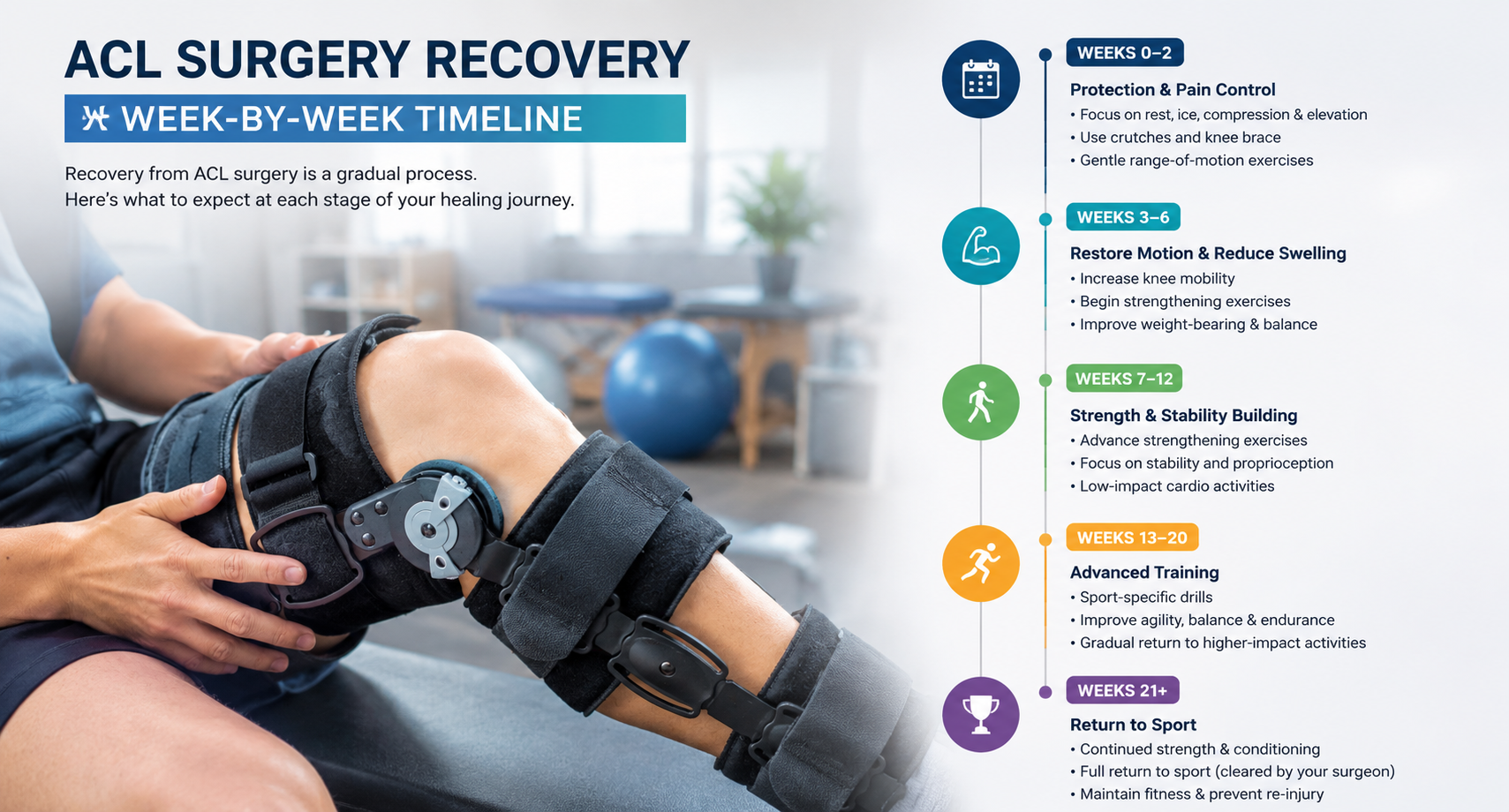
ACL surgery recovery timeline showing week-by-week rehabilitation phases and return-to-sport milestones in India
Why recovery takes longer than expected

The Biological Reason ACL Recovery Takes 9–12 Months

The graft goes through a process called ligamentisation — the transformation from transplanted tendon into functioning ligament. Feeling pain-free at 3 months does not mean the graft is ready for sport. Here are the three stages:

1
Necrosis Phase
Weeks 1–6 · Most Vulnerable Period
The graft loses its original blood supply and temporarily weakens. This is the highest-risk period — the graft can fail under moderate load. No running, twisting, or pivoting under any circumstances.
2
Revascularisation Phase
Weeks 6–16 · Graft Begins Strengthening
New blood supply grows into the graft. Strength begins to return. This is when most patients feel ready to run — but the graft is still far below full structural strength. Premature loading here is the most common cause of re-rupture.
3
Ligamentisation Phase
Months 4–24 · Full Graft Maturation
The graft slowly remodels into functional ligament tissue. Full histological maturation takes 12–24 months. Return-to-sport decisions at 6–9 months must be based on objective functional testing — not pain level or appearance of the knee.
⚠ The Most Dangerous Misconception in ACL Recovery
Pain-free and swelling-free does not mean healed. Most ACL graft re-ruptures in India occur between 3–6 months post-surgery — when patients feel good enough to return to sport but the graft has not completed ligamentisation. Return-to-sport decisions must be based on functional testing, not symptoms alone.
Phase by phase

Complete Week-by-Week ACL Recovery Timeline

The following five-phase timeline is used at Shivaan Hospital. Individual milestones vary by graft type, surgical findings, and patient fitness — all targets confirmed at each surgical review with Dr. Donda:

P1
Phase 1 — Protection & Pain Control
Weeks 1–2
Goal: Reduce swelling. Prevent quad shutdown. Protect graft.
Walk with crutches only. Ice 20 minutes every 2–3 hours. Keep leg elevated. Perform gentle quad sets, ankle pumps, and straight leg raises hourly while awake. Achieve full knee extension (0°) by end of Week 2 — failure to do so causes long-term extension deficit.
✓ Quad sets ✓ Ankle pumps ✓ Ice & elevation ✗ Weight bearing alone ✗ Twisting / pivoting
P2
Phase 2 — Restore Range of Motion
Weeks 3–6
Goal: Full weight bearing. Achieve 0–120° range of motion.
Crutches discarded as walking normalises. Stationary cycling introduced at Week 3–4 — the best early cardio option. Target 90° flexion by Week 3 and 120° by Week 6. Hydrotherapy and pool walking begin if available. Gentle closed-chain strengthening introduced under physiotherapy supervision.
✓ Stationary cycling ✓ Pool walking ✓ Gentle CKC exercises ✗ Running ✗ Lateral agility
P3
Phase 3 — Rebuild Muscle Strength
Weeks 7–12
Goal: 70–80% quad symmetry. Prepare for running.
Formal gym-based strengthening begins: leg press, step-ups, hamstring curls (graft-type dependent), terminal knee extensions. Cycling on a road or stationary bike at resistance. Quad symmetry is tested — the critical milestone before running clearance is 70% Limb Symmetry Index on single-leg hop testing.
✓ Leg press & step-ups ✓ Hamstring curls ✓ Proprioception training ✗ Running or jumping ✗ Sport drills
P4
Phase 4 — Functional Training
Months 4–6
Goal: Running programme. Sport-specific movement patterns.
Walk-run intervals on flat surface introduced when LSI exceeds 70%. Full running followed by agility ladder, cutting drills, and sport-specific movement. Deceleration and single-leg landing training — the highest-risk movements for re-rupture — must be formally trained, not assumed. Neuromuscular control is the focus.
✓ Running programme ✓ Agility & cutting drills ✓ Landing mechanics ✗ Competitive sport ✗ Contact training
P5
Phase 5 — Return to Sport
Months 6–9+
Goal: Pass functional testing battery. Competitive sport clearance.
Return to full competitive sport only after passing all four criteria: (1) Limb Symmetry Index >90% on hop tests, (2) Isokinetic quad/hamstring strength >90%, (3) Y-Balance within 4 cm, (4) ACL-RSI psychological readiness score. Patients passing all four have re-rupture rates under 4%. Time-based return alone carries 15–25% re-rupture risk.
✓ LSI >90% hop tests ✓ Strength >90% ✓ ACL-RSI cleared ✗ Time alone = clearance
Critical milestones

4 Key Milestones That Determine Your Recovery Trajectory

Missing any of these milestones flags a recovery that needs closer specialist review — not simply more time:

By Week 2
Full Knee Extension (0°)
Extension deficit at Week 2 leads to a permanent flexion contracture that is extremely difficult to correct and significantly impacts long-term function. Ice, prone hanging, and heel props are used to achieve 0° extension early.
By Week 6
120° Flexion & Crutch-Free Walking
Normal walking gait should be restored by Week 6. Persistent antalgic gait (limping) beyond this point indicates ongoing pain or quad weakness that requires physiotherapy reassessment rather than more time alone.
By Month 3–4
70% Quad Symmetry (LSI)
Running is not safe below 70% quad strength symmetry. Isokinetic testing or single-leg hop testing confirms this milestone. Patients who run before reaching 70% LSI have significantly higher re-rupture rates regardless of how the knee feels.
Month 6–9
Pass Full Functional Testing Battery
LSI >90%, isokinetic strength >90%, Y-Balance within 4 cm, and ACL-RSI psychological readiness score — all four must be passed before competitive sport. This is the difference between a 4% and a 25% re-rupture rate.
Choosing your graft

ACL Graft Options in India — Which Is Right for You?

The graft choice is made at pre-operative consultation based on your sport, age, previous surgeries, and anatomy. Here is how the main options compare:

Most Popular in India
Autograft
Hamstring Tendon
Source: Patient's own hamstring (semitendinosus / gracilis)
Best forMost patients — cricketers, footballers, recreational athletes
ProExcellent strength, large graft diameter, low donor-site pain
NoteSlight hamstring weakness for 6–12 months; recovers fully in most patients
Elite Athletes
Autograft
Patellar Tendon (BTB)
Source: Patient's own kneecap tendon with bone plugs
Best forElite athletes in high-pivot sports; previous hamstring surgery
ProGold standard for re-rupture prevention in pivoting sports; bone-to-bone healing fastest
NoteAnterior knee pain at kneeling common; not recommended for patients spending long time on knees
Revision Cases
Autograft
Quadriceps Tendon
Source: Patient's own quadriceps tendon
Best forRevision ACL; large graft diameter needed; previous hamstring or patellar tendon used
ProLargest available autograft; excellent strength; growing evidence base
NoteMinimal donor-site morbidity; increasingly preferred by fellowship-trained surgeons
Specific Indications
Allograft
Donor (Cadaver) Tissue
Source: Processed cadaver tendon
Best forRevision cases; older patients; multi-ligament reconstruction
ProNo donor-site pain; shorter operative time; multiple grafts available
NoteHigher re-rupture rate in young active patients — not recommended under 25 for competitive sport
Dr. Donda's Approach to Graft Selection
For most first-time ACL reconstruction patients — including cricketers, footballers, and recreational athletes — hamstring autograft provides an excellent combination of strength, diameter, and low donor-site morbidity. Patellar tendon grafts are preferred for elite athletes in high-pivot sports and revision cases. Every decision is made individually at pre-operative consultation — not based on routine alone.
Avoid these at all costs

5 Mistakes That Cause ACL Graft Re-Rupture in India

These five mistakes account for the majority of preventable ACL graft failures seen at Indian orthopaedic clinics — including at Shivaan Hospital in patients referred from other centres:

01
Returning to sport based on time alone
The calendar does not determine graft readiness. Patients who return to competitive sport at 6 months without passing functional testing have re-rupture rates of 15–25% — compared to under 4% for those who pass the full testing battery regardless of timeline.
02
Stopping physiotherapy when the knee "feels normal"
The graft is still maturing at Month 6–9 and requires continued neuromuscular training even when pain-free. Stopping rehab prematurely leaves proprioceptive deficits that significantly increase re-rupture risk during dynamic sport movements.
03
Skipping deceleration and landing phase training
Uncontrolled deceleration and single-leg landing are the highest-risk movements for ACL re-rupture. Most Indian rehabilitation programmes focus on strengthening but skip formal landing mechanics training — leaving patients vulnerable at the moments of peak risk.
04
Running before reaching 70–80% quad strength symmetry
The quadriceps is the primary dynamic stabiliser protecting the ACL graft. Running with quad weakness below 70% LSI places the graft under load it is not structurally prepared for — regardless of how stable the knee feels during walking.
05
Ignoring psychological readiness (ACL-RSI)
Fear of re-injury causes compensatory movement patterns — altered landing mechanics, reduced hip flexion, stiffened knee — that paradoxically increase re-rupture risk. Low ACL-RSI scores are independently associated with higher re-rupture rates even in physically recovered patients.
Why Surat athletes choose Shivaan

Why Choose Shivaan Hospital for ACL Surgery and Rehabilitation?

Fellowship-trained ACL surgery with integrated rehabilitation and objective return-to-sport testing — in Surat, without travelling to Mumbai or Ahmedabad.

Fellowship-Trained Arthroscopic ACL Reconstruction
Dr. Donda trained at Germany's highest-volume arthroplasty and sports injury centre — bringing European-standard ACL surgical technique and rehabilitation protocols to Surat.
Individualised Graft Selection — Not Routine Defaults
Hamstring, patellar tendon, or quadriceps tendon — selected based on your specific sport, anatomy, previous surgeries, and long-term activity goals at pre-operative consultation.
Integrated Physiotherapy with 5-Phase ACL Protocol
Structured rehabilitation from Week 1 through return-to-sport — overseen by Dr. Donda's team with milestone reviews at each phase transition, not discharged after 6 weeks.
Objective Return-to-Sport Testing — Not Time-Based Clearance
LSI hop testing, isokinetic strength assessment, Y-Balance, and ACL-RSI psychological readiness — all four assessed before competitive sport clearance. The standard that reduces re-rupture to under 4%.
Cricket and Sport-Specific Rehabilitation
Protocols designed for batting, bowling, and fielding demands — not generic gym programmes. Bowling load management for fast bowlers and rotational power training for batsmen and fielders.
When to see Dr. Donda

When to Book an ACL Consultation at Shivaan Hospital

Do not delay assessment — the difference between early and late diagnosis determines whether reconstruction is straightforward or complex:

A pop in the knee followed by rapid swelling after a sudden direction change, landing, or contact injury
Knee giving way or feeling unstable during sport or even normal walking on uneven ground
You have an MRI showing ACL tear — partial or complete — and need specialist opinion on surgical vs. non-surgical management
You are an athlete given conflicting advice about graft type or return-to-sport timeline
You are 3+ months post-ACL surgery and have not yet received formal functional testing clearance for your sport
You have had a previous ACL repair now causing recurring instability or you want a second opinion before revision surgery
Patient questions answered

Frequently Asked Questions

The most common questions from patients and athletes about ACL surgery and recovery at Shivaan Hospital, Surat.

How long does ACL surgery recovery take in India?
Full recovery to competitive sport typically takes 9–12 months with a structured rehabilitation programme. Return to sport at 6 months is possible but requires passing all four functional tests — LSI, isokinetic strength, Y-Balance, and ACL-RSI. Rushing before 9 months without testing significantly increases re-rupture risk.
When can I walk normally after ACL surgery?
Most patients walk without crutches by Weeks 2–3 post-surgery. Full comfortable walking on varied surfaces is typically achieved by Weeks 4–6. Walking pace on flat surfaces is usually pain-free by Week 6 in well-progressing patients.
Can ACL heal without surgery in India?
Partial ACL tears with preserved knee stability can sometimes be managed non-surgically — particularly in older, lower-activity patients. Complete ACL tears in active patients and athletes almost always require reconstruction to restore full stability and prevent progressive meniscus and cartilage damage from repeated instability episodes.
Which graft is best for ACL reconstruction in India?
Hamstring autograft is the most commonly used graft in India and provides excellent outcomes for most patients. Patellar tendon (BTB) graft is preferred for elite athletes in high-pivot sports. The best graft for your specific situation is determined at pre-operative consultation based on sport, anatomy, and previous surgical history.
When can I play cricket after ACL surgery?
Return to batting and fielding drills typically begins at Months 5–6. Return to bowling — which involves high deceleration forces — should not occur before Month 6–9 and only after passing the full functional testing battery. Fast bowlers require a structured bowling load management programme before returning to match play.
Why does my knee still swell at 3 months after ACL surgery?
Intermittent swelling at 3 months is common after increased activity — it typically indicates that the rehabilitation load is progressing faster than the joint's inflammatory capacity. Reduce load, ice the knee, and inform your physiotherapist. Persistent or significant swelling warrants an orthopaedic review to rule out graft issues or meniscus problems.
Is ACL surgery available in Surat?
Yes. Arthroscopic ACL reconstruction is performed by Dr. Krunal Donda at Shivaan Hospital, Surat. Patients from South Gujarat, Navsari, Bharuch, Valsad, and surrounding areas no longer need to travel to Mumbai or Ahmedabad for fellowship-quality ACL surgery and structured rehabilitation.
How do I know if my ACL graft has failed?
Signs of possible graft failure include recurrence of the original instability sensation, a pop during activity, rapid significant swelling, or a positive Lachman test on clinical examination. If any of these occur — especially in the first 12 months — see a specialist immediately for clinical and MRI assessment.
What is the ACL-RSI score and why does it matter?
The ACL Return to Sport after Injury (ACL-RSI) is a validated psychological readiness questionnaire assessing emotions, confidence, and risk appraisal before return to sport. Low ACL-RSI scores — indicating fear of re-injury — are independently associated with higher re-rupture rates regardless of physical recovery status. It is a mandatory part of the return-to-sport assessment at Shivaan Hospital.
How do I book an ACL consultation at Shivaan Hospital?
Call or WhatsApp +91 98790-99184, visit Infinity Tower, Lal Darwaja Station Road, Surat, or book at shivaanhospital.com. Bring your MRI report. Dr. Donda reviews graft options, surgical approach, and full recovery timelines at your first appointment. Same-day appointments often available for acute injuries.
Book your consultation

Your ACL Recovery Starts With the Right Surgery — and the Right Plan.

Book a pre-surgical ACL consultation with Dr. Krunal Donda at Shivaan Hospital, Surat. Receive graft selection advice, a complete 5-phase recovery timeline, and a transparent written package estimate.

Graft selection consultation at first appointment
5-phase ACL rehabilitation protocol from Week 1
Objective functional testing before sport clearance
Cricket and sport-specific return programme
Call / WhatsApp
+91 98790-99184
Location
Infinity Tower, Lal Darwaja Station Road, Surat
Website
shivaanhospital.com

Leave a Comment

Your email address will not be published. Required fields are marked *

Scroll to Top