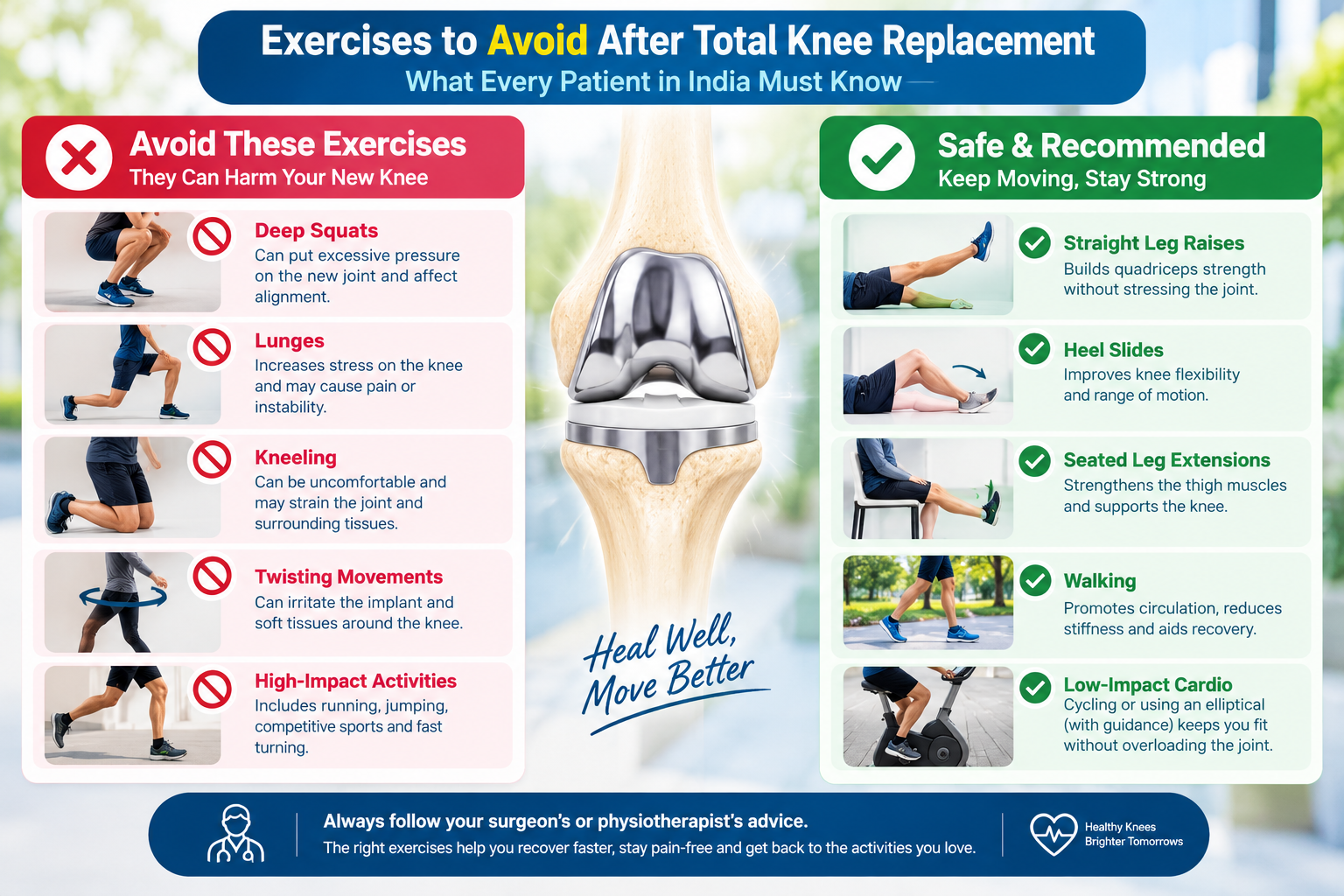
Why exercise guidance matters
How Wrong Exercise Damages Your Knee Implant
A modern total knee replacement has three components — each vulnerable to different types of activity-related damage. Understanding this helps you see exactly why certain exercises must be avoided permanently. For the full surgical pathway, see our guide on total knee replacement surgery in Surat. Patients comparing non-surgical options can also review PRP therapy and signs you need a knee replacement.
🦴
Femoral Component
Metal component that caps the end of the thigh bone. Vulnerable to loosening from rotational forces (pivoting, twisting)
⬛
Polyethylene Bearing
Plastic surface between metal components. Vulnerable to accelerated wear from high-impact loading (running, jumping)
🦷
Tibial Baseplate
Metal plate anchored to the shin bone. Vulnerable to loosening from deep flexion loads (squatting below 90°, kneeling)
1
Bearing Wear
High-impact repetitive loading accelerates polyethylene degradation — producing wear particles that trigger bone-dissolving inflammation (osteolysis), loosening the implant from within.
2
Implant Loosening
Rotational forces and excessive flexion stress the implant-bone interface. Early loosening within 5 years is almost always activity-related in well-fixed primary TKRs.
⚠ Important for Indian Patients Specifically
Several common Indian lifestyle activities place TKR implants under significant stress that Western rehabilitation guidelines don't address: sitting cross-legged (padmasan) for prayer or family meals, squatting at low Indian-style toilets, floor-level sleeping arrangements, and kneeling for religious practice. Discuss each of these specifically with Dr. Donda at your post-operative reviews — modifications are available for all of them.
Patient questions answered
Frequently Asked Questions
The most common questions from TKR patients in Surat about exercise, activity, and protecting their implant long-term. Related reading: knee replacement cost in Surat and physical therapy at Shivaan Hospital.
Can I do yoga after total knee replacement?
Many yoga poses are safe after TKR — provided they avoid deep knee flexion beyond 90° and rotational stress on a fixed foot. Shavasana, gentle forward bends, and supported standing poses are generally fine. Poses involving squatting, kneeling, lotus position, or hero pose (Virasana) must be permanently avoided. Always inform your yoga instructor of your TKR before participating.
Can I sit on the floor or use an Indian toilet after TKR?
Both involve deep knee flexion that stresses the implant. For Indian toilets, a raised toilet seat adaptor is strongly recommended — available at medical supply shops in Surat. For floor seating, a low chair or bolster that keeps the knee at 90° or above is preferable to full floor sitting. Discuss specific modifications with your physiotherapist at Shivaan Hospital.
Can I run after total knee replacement?
Running is generally not recommended for standard TKR implants due to the 3–5× body weight impact forces generated at each heel-strike — which dramatically accelerate bearing wear. Some surgeons allow limited running in younger, lighter patients with premium bearing surfaces, but this must be a specific individualised discussion with Dr. Donda based on your implant type and patient factors.
When can I climb stairs after knee replacement?
Most patients can climb stairs with a railing within 1–2 weeks, starting with one step at a time (good leg up first, operated leg down first — "up with the good, down with the bad"). Normal alternating-foot stair climbing is typically achieved by Week 4–6. There are no permanent restrictions on stair use after TKR.
Can I play cricket after knee replacement?
Recreational batting and fielding in stationary position may be possible after 6–12 months. Fast bowling, running between wickets, and diving are not recommended — these generate rotational and impact forces that stress the implant. Discuss return to specific cricket roles at your 6-month review with Dr. Donda based on your implant type.
Is cycling safe after knee replacement?
Yes — stationary cycling is one of the best TKR exercises from Week 3–4. Outdoor cycling on flat terrain is appropriate from Month 3–4. Adjust the seat height so the knee does not flex beyond 90° at the bottom of the pedal stroke. Avoid rough terrain and standing pedalling on hills that require the knee to go through deep flexion under high load.
Can I do squats after total knee replacement?
Full deep squats are permanently avoided after TKR. Chair squats — controlled sit-to-stand to a maximum of 90° of knee flexion — are safe and actually recommended as a functional strengthening exercise. The critical rule: never allow the knee to flex beyond 90° under load, whether in the gym, at home, or during daily activities.
What happens if I accidentally do a restricted exercise?
One incident rarely causes immediate implant damage — the risks are cumulative. If you accidentally perform a restricted activity, avoid repeating it, monitor for any new pain or swelling over 48 hours, and mention it at your next review appointment. If new symptoms develop within 48 hours of the activity, contact Shivaan Hospital promptly for assessment.
How long do I need to do physiotherapy after knee replacement?
Formal physiotherapy sessions are typically needed for 6–8 weeks post-surgery. However, home exercises — particularly walking, cycling, and range-of-motion work — should continue for at least 3–6 months. The overall process of building strength, confidence, and activity habits takes 6–12 months and benefits from annual check-in reviews thereafter.
How do I book a post-TKR review at Shivaan Hospital?
Call or WhatsApp +91 98790-99184, visit Infinity Tower, Lal Darwaja Station Road, Surat, or book at shivaanhospital.com. All TKR patients at Shivaan Hospital receive a structured review schedule — 6 weeks, 3 months, 6 months, 1 year, and annually. Physiotherapy is integrated into the recovery programme with milestone-based activity clearances at each visit.