Gout vs Arthritis India — How to Tell the Difference — Shivaan Hospital Surat
Joint Pain Diagnosis Guide · Surat 2026

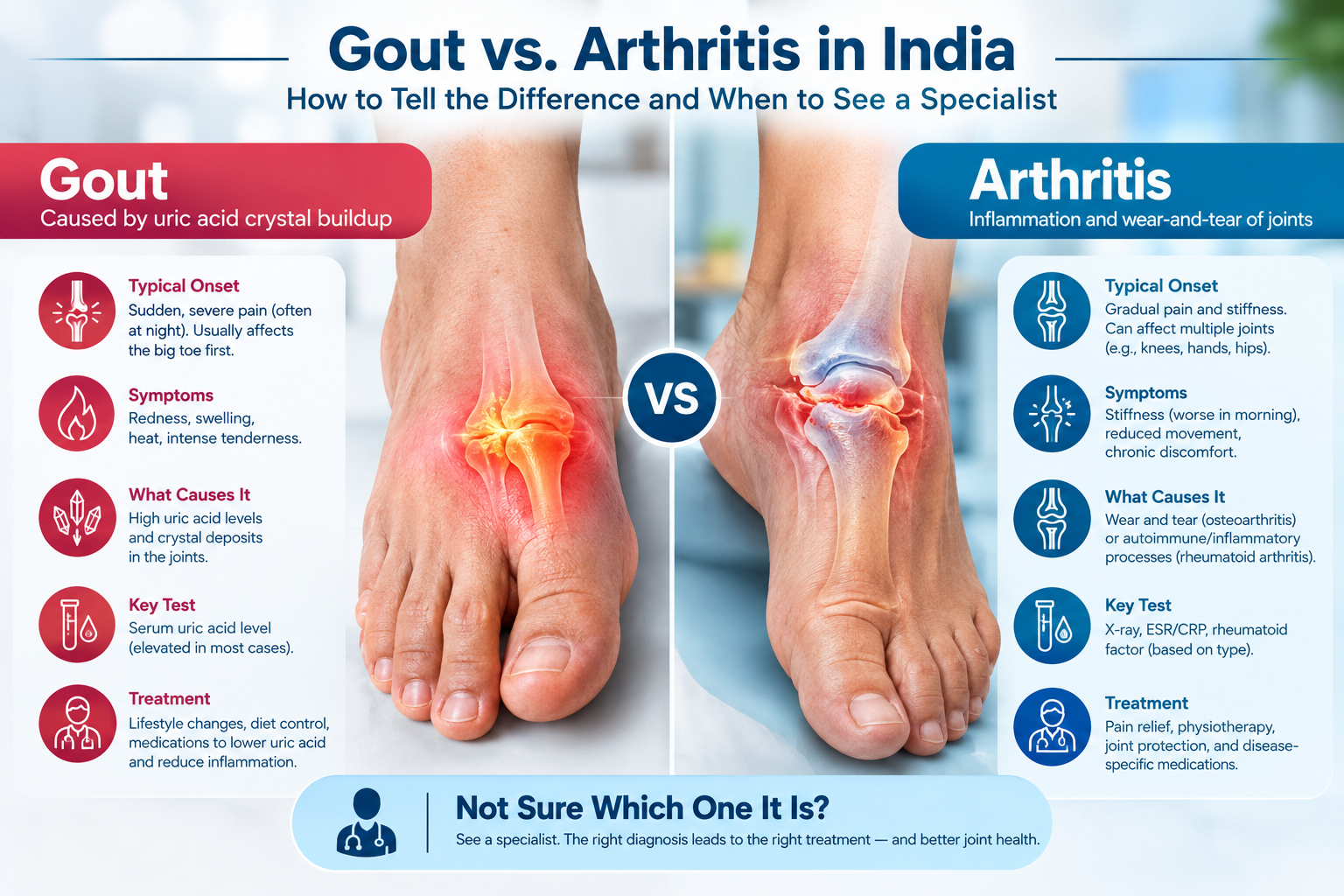
Gout vs. Arthritis in India: How to Tell the Difference and When to See a Specialist

Prafulbhai, 48, woke at 3 AM with excruciating pain in his right big toe. His wife assumed arthritis. His pharmacist gave a painkiller. Two weeks later — the pain vanished completely. Six months later, it returned in his knee.

A simple blood test and joint assessment revealed gout — not arthritis. The treatment was entirely different. The outcome, once correctly diagnosed, was excellent.
📍 Shivaan Hospital, Surat 🩺 Dr. Krunal Donda ⏱ 8 min read
At a glance
Gout
Sudden severe attack · Big toe / ankle · Resolves completely · Uric acid crystals
Osteoarthritis
Gradual worsening · Knees / hips · Worse with activity · Cartilage wear
Rheumatoid Arthritis
Morning stiffness >1 hr · Symmetric · Systemic symptoms · Autoimmune
Illustration comparing gout and arthritis, showing a red, swollen big toe affected by gout and joint changes associated with arthritis.
Why the confusion happens

Why Gout and Arthritis Are So Frequently Confused in India

Both conditions cause joint pain, swelling, and reduced mobility — which is why they are routinely mistaken for each other. The critical point: the treatment for gout is fundamentally different from the treatment for arthritis. Getting the diagnosis wrong means treating the wrong disease for years. At Shivaan Hospital we assess this carefully as part of arthritis clinic care and comprehensive pain management. Patients with advanced joint wear may also need evaluation for total knee replacement or GFC / PRP therapy.

Both can affect the knee — the most commonly treated orthopaedic joint in India, making localisation alone useless for diagnosis
Both cause intermittent pain that can settle between episodes — leading patients to dismiss them as "muscle strain" or "weather-related"
Both occur more frequently in middle-aged adults with metabolic conditions like diabetes and hypertension — the same demographic
Gout is frequently called 'vat rog' in Gujarati and attributed to lifestyle without formal medical blood test assessment
Standard painkillers (NSAIDs) reduce pain in both conditions — which masks the underlying difference without treating the cause
Know each condition

Understanding the Three Conditions Most Commonly Confused

In the context of joint pain confusion in India, three conditions account for the vast majority of misdiagnoses. Here is what defines each one. For ongoing knee symptoms after diagnosis, see also our guides on GFC / PRP therapy for knee arthritis and signs you need a knee replacement:

Inflammatory Arthritis
Gout
💡 Sudden severe attack — often overnight — then completely pain-free
Caused by uric acid crystal deposits — not cartilage wear
Classic joint: big toe (podagra), ankle, knee, wrist
40+ million Indians have high uric acid — most undiagnosed
Triggered by diet, alcohol, dehydration, or medications
Fully treatable with uric acid-lowering drugs
Degenerative Arthritis
Osteoarthritis (OA)
💡 Gradual worsening over months/years — worse with activity
Caused by cartilage breakdown over time — not crystals
Affects weight-bearing joints: knees, hips, spine
180+ million Indians affected — leading cause of TKR surgery
Morning stiffness under 30 minutes; pain worse with activity
Managed with physio, PRP, injections, and eventually surgery
Autoimmune Arthritis
Rheumatoid Arthritis (RA)
💡 Symmetric joints, morning stiffness >1 hour, systemic fatigue
Immune system attacking the joint lining (synovium)
Affects both sides equally — hands, wrists, knees symmetric
Women affected 3× more than men; any age at onset
Requires rheumatologist with DMARDs — not just painkillers
Early treatment achieves remission in up to 60% of patients
Side by side

Gout vs. Osteoarthritis vs. Rheumatoid Arthritis: Full Comparison

Every clinically significant difference between the three conditions — so you can identify which matches your symptoms and understand why accurate diagnosis matters:

Feature Gout 🔵 Osteoarthritis (OA) 🟢 Rheumatoid Arthritis (RA) 🔴
Root causeUric acid crystal deposits in jointCartilage wear and degenerationImmune system attacking joint lining
Who gets itMen 30–60; post-menopausal women; purine-rich diet; alcoholAdults 50+; overweight; physically demanding jobsWomen > men; any age; autoimmune trigger
Joints affectedBig toe, ankle, knee, wrist — asymmetricKnees, hips, hands, spine — weight-bearingBoth sides equally — hands, wrists, knees symmetric
Pain patternSudden severe attacks then completely pain-freeGradual worsening; worse with activityMorning stiffness >1 hour; constant pain; fatigue
Speed of onsetExtremely fast — intense pain within hours overnightGradual — months to years of worseningGradual — weeks to months of onset
Key blood testHigh serum uric acid (>7 mg/dL men, >6 mg/dL women)Usually normal — diagnosis is clinical + X-rayHigh CRP/ESR; positive RF or anti-CCP antibodies
Definitive testJoint aspiration — urate crystals under microscopyX-ray: joint space narrowing, osteophytesAnti-CCP antibody + clinical criteria
Risk if ignoredTophi; joint destruction; kidney stones; renal failureProgressive disability; joint replacement neededSevere joint erosions; systemic organ involvement
TreatmentAllopurinol; dietary change; acute attack managementPhysio; weight loss; PRP; injections; TKR if neededDMARDs (methotrexate); biologics; rheumatologist
⚠ The One Test That Confirms Gout — Nothing Else Does
The definitive diagnosis of gout is joint aspiration — removing fluid from the affected joint and examining it under polarised light microscopy for monosodium urate crystals. A high serum uric acid level is suggestive but not diagnostic — uric acid can even be normal during an acute attack. If your doctor diagnoses gout based only on a blood test without joint assessment, request specialist confirmation.
Getting the right tests

How Each Condition Is Accurately Diagnosed

A correct diagnosis requires clinical examination plus targeted investigations. Here is the diagnostic pathway for each condition at Shivaan Hospital:

Diagnostic TestDetectsKey Finding
Serum Uric AcidGout (suggestive)Above 7 mg/dL in men or 6 mg/dL in women suggests gout — but can be normal during an acute attack; not definitive alone
Joint Aspiration (Gold Standard)Gout (definitive)Monosodium urate crystals under polarised light microscopy — the only definitive test for gout; cannot be replaced by blood tests
CRP / ESRInflammatory arthritis (RA)Elevated in RA and all inflammatory conditions; usually normal or only mildly elevated in osteoarthritis
RF / Anti-CCP AntibodiesRheumatoid ArthritisPositive in 70–80% of RA patients; anti-CCP is more specific and appears earlier in disease course
Weight-Bearing X-RayOA / chronic goutJoint space narrowing and osteophytes confirm OA; punched-out erosions in subchondral bone suggest chronic tophaceous gout
MRI / Musculoskeletal UltrasoundEarly disease; soft tissueDetects cartilage loss, synovitis, tophi deposits, and bony erosions before X-ray changes are visible — essential for early diagnosis
The cost of delayed diagnosis

What Happens If Each Condition Is Left Untreated?

All three conditions cause irreversible damage if ignored — but the type of damage, timeline, and prevention strategy are entirely different for each:

Untreated Gout
Timeline: 5–10 years
Progressive joint cartilage damage from repeat attacks
Tophi deposits under skin in tendons and bones
Permanent joint deformity — especially fingers and feet
Urate kidney stones — painful and potentially obstructive
Chronic kidney disease from sustained hyperuricaemia
Untreated Osteoarthritis
Timeline: Progressive — years
Cartilage erosion progressing to bone-on-bone contact
Loss of window for non-surgical management (PRP, physio)
Progressive joint deformity — varus/valgus deformity
Complete joint failure requiring knee or hip replacement
Muscle wasting and loss of independence in daily tasks
Untreated Rheumatoid Arthritis
Timeline: 1–2 years for erosions
Irreversible bony erosions within 1–2 years of onset
Remission impossible once established disease takes hold
Systemic involvement: heart, lungs, blood vessels
Severe joint deformity — swan neck, boutonniere fingers
Accelerated cardiovascular disease risk
Why Surat patients choose Shivaan

Why Choose Shivaan Hospital for Joint Pain Assessment?

Distinguishing gout from OA from RA requires clinical expertise, targeted investigations, and integrated management — not just a blood test and a painkiller prescription.

Fellowship Orthopaedic Assessment
Dr. Donda's clinical expertise distinguishes gout from OA from RA at the first appointment
Complete On-Site Diagnostics
Uric acid, CRP/ESR, RF, anti-CCP, X-ray, and ultrasound all available at Shivaan Hospital
Joint Aspiration Capability
The only definitive gout test — performed under sterile technique with immediate assessment
Rheumatology Referral Network
Coordinated referral for RA patients requiring DMARD therapy and rheumatologist co-management
OA Non-Surgical Management
GFC / PRP therapy, physiotherapy, weight management, and injections for arthritis patients before surgery
Gout Dietary Counselling
Uric acid-lowering therapy plus targeted dietary and lifestyle advice addressing the metabolic root cause
Urgency guide

When to See a Specialist — Immediately vs. Soon

Not all joint pain requires emergency attention — but some does. Here is how to decide how urgently you need to be seen:

See a Specialist Immediately
Within 24–48 hours
Sudden, severe joint pain appearing overnight — especially big toe, ankle, or knee
Joint that is hot, red, and swollen with any fever — septic arthritis must be excluded urgently
You are on diuretics (blood pressure medication) and develop acute joint pain
Gout attack pain not responding to NSAIDs within 48 hours
See a Specialist Soon
Within 1–2 weeks
Recurring episodes of joint pain — even if resolved on their own — without a formal diagnosis
Joint stiffness lasting more than 45 minutes every morning
Visible swelling in multiple small joints simultaneously — especially hands
Uric acid blood test above 7 mg/dL even without pain — requires management
Joint pain with unexplained weight loss, fatigue, or persistent low-grade fever
Patient questions answered

Frequently Asked Questions

The most common questions from patients trying to understand whether they have gout, osteoarthritis, or rheumatoid arthritis.

What is the main difference between gout and arthritis?
Gout is caused by uric acid crystal deposits and produces sudden, severe attacks that resolve completely between episodes. Osteoarthritis is cartilage wear causing gradual, progressive joint pain worse with activity. Rheumatoid arthritis is autoimmune — symmetric, with morning stiffness and systemic symptoms. Each requires entirely different treatment.
What foods cause gout attacks in India?
High-purine foods common in India include red meat, organ meats (liver, kidney, brain), shellfish (prawns, crab), and spinach in large quantities. Beer is particularly gout-triggering due to its purine content and direct inhibition of uric acid excretion. All alcohol raises uric acid to some degree.
Can gout be cured permanently?
Gout cannot be cured, but it can be completely controlled. Uric acid-lowering medication (allopurinol or febuxostat), taken consistently, reduces uric acid to below the crystal formation point — preventing attacks entirely in most patients. It requires lifelong management, not just acute treatment during attacks.
Can you have both gout and osteoarthritis?
Yes — both conditions can coexist, and the same joint can be affected by both. OA joints are actually more susceptible to urate crystal deposition. Both conditions need to be identified and managed separately — this is why clinical assessment and targeted investigations matter more than a single blood test.
Is gout a sign of kidney disease?
Gout and kidney disease have a bidirectional relationship. Chronic kidney disease impairs uric acid excretion, causing gout. Sustained hyperuricaemia can also damage the kidneys directly. All patients with confirmed gout should have kidney function assessed regularly.
Is uric acid the same as arthritis?
No. Elevated uric acid (hyperuricaemia) is the metabolic condition that causes gout — but uric acid is not the cause of osteoarthritis or rheumatoid arthritis. Many people have elevated uric acid without ever developing gout. The terms are often used interchangeably in India, leading to significant incorrect dietary advice and missed diagnoses.
How do I know if my joint pain is gout or a sports injury?
Gout attacks are spontaneous — not triggered by a specific injury. They develop overnight or after dietary or alcohol excess, affect typical gout joints, and produce intense redness disproportionate to any trauma. Sports injuries have a clear mechanism of injury and typically show swelling without the extreme warmth and redness of gout.
What is the normal uric acid level in India?
Normal serum uric acid is below 7 mg/dL in men and below 6 mg/dL in women. Levels above these thresholds increase the risk of urate crystal formation. However, some patients develop gout at lower levels, and some with levels above 9 mg/dL never develop gout — individual susceptibility varies significantly.
Can arthritis cause high uric acid?
Osteoarthritis and rheumatoid arthritis do not directly cause high uric acid. However, medications used for arthritis — particularly diuretics for blood pressure — can raise uric acid significantly. Always test uric acid separately from general arthritis investigations to avoid confusing the two findings.
How do I book a joint pain assessment at Shivaan Hospital?
Call or WhatsApp +91 98790-99184, visit Infinity Tower, Lal Darwaja Station Road, Surat, or book at shivaanhospital.com. Bring any previous blood tests or X-rays. Dr. Donda assesses the cause of joint pain at the first appointment — distinguishing gout from arthritis on the same day.
Book your joint assessment

Stop Guessing. Get an Accurate Diagnosis at Shivaan Hospital.

Book a joint pain assessment with Dr. Krunal Donda at Shivaan Hospital, Surat. Receive clinical examination, targeted blood tests, imaging review, and a clear diagnosis — distinguishing gout from osteoarthritis from rheumatoid arthritis at the same appointment.

Call / WhatsApp
+91 98790-99184
Location
Infinity Tower, Lal Darwaja Station Road, Surat
Website
shivaanhospital.com
40M+
Indians with high uric acid — most undiagnosed
180M
Indians with osteoarthritis — leading cause of disability
60%
RA remission rate with early correct treatment

Leave a Comment

Your email address will not be published. Required fields are marked *

Scroll to Top