
Gout vs. Arthritis in India: How to Tell the Difference and When to See a Specialist
A simple blood test and joint assessment revealed gout — not arthritis. The treatment was entirely different. The outcome, once correctly diagnosed, was excellent.
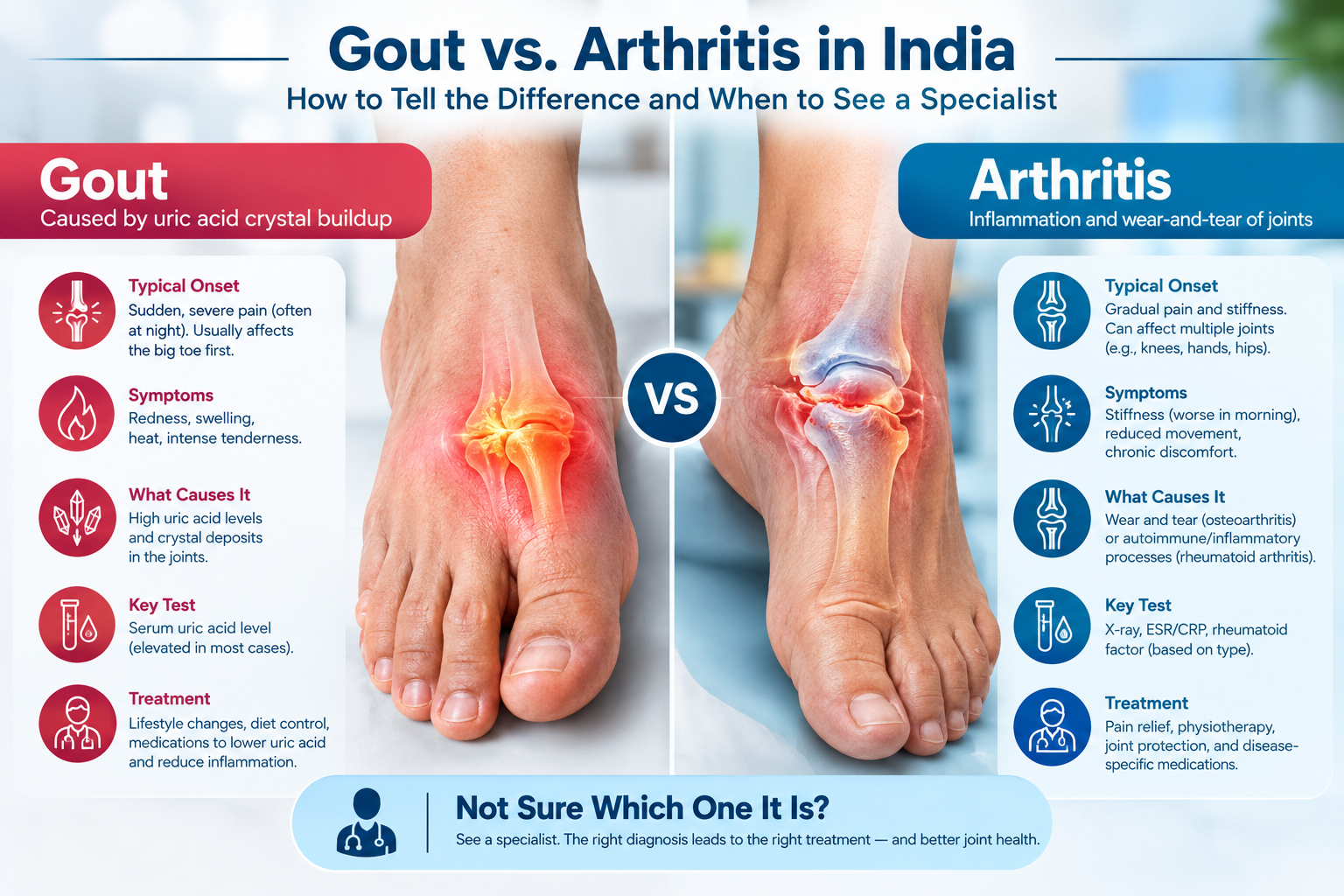
Why Gout and Arthritis Are So Frequently Confused in India
Both conditions cause joint pain, swelling, and reduced mobility — which is why they are routinely mistaken for each other. The critical point: the treatment for gout is fundamentally different from the treatment for arthritis. Getting the diagnosis wrong means treating the wrong disease for years. At Shivaan Hospital we assess this carefully as part of arthritis clinic care and comprehensive pain management. Patients with advanced joint wear may also need evaluation for total knee replacement or GFC / PRP therapy.
Understanding the Three Conditions Most Commonly Confused
In the context of joint pain confusion in India, three conditions account for the vast majority of misdiagnoses. Here is what defines each one. For ongoing knee symptoms after diagnosis, see also our guides on GFC / PRP therapy for knee arthritis and signs you need a knee replacement:
Gout vs. Osteoarthritis vs. Rheumatoid Arthritis: Full Comparison
Every clinically significant difference between the three conditions — so you can identify which matches your symptoms and understand why accurate diagnosis matters:
| Feature | Gout 🔵 | Osteoarthritis (OA) 🟢 | Rheumatoid Arthritis (RA) 🔴 |
|---|---|---|---|
| Root cause | Uric acid crystal deposits in joint | Cartilage wear and degeneration | Immune system attacking joint lining |
| Who gets it | Men 30–60; post-menopausal women; purine-rich diet; alcohol | Adults 50+; overweight; physically demanding jobs | Women > men; any age; autoimmune trigger |
| Joints affected | Big toe, ankle, knee, wrist — asymmetric | Knees, hips, hands, spine — weight-bearing | Both sides equally — hands, wrists, knees symmetric |
| Pain pattern | Sudden severe attacks then completely pain-free | Gradual worsening; worse with activity | Morning stiffness >1 hour; constant pain; fatigue |
| Speed of onset | Extremely fast — intense pain within hours overnight | Gradual — months to years of worsening | Gradual — weeks to months of onset |
| Key blood test | High serum uric acid (>7 mg/dL men, >6 mg/dL women) | Usually normal — diagnosis is clinical + X-ray | High CRP/ESR; positive RF or anti-CCP antibodies |
| Definitive test | Joint aspiration — urate crystals under microscopy | X-ray: joint space narrowing, osteophytes | Anti-CCP antibody + clinical criteria |
| Risk if ignored | Tophi; joint destruction; kidney stones; renal failure | Progressive disability; joint replacement needed | Severe joint erosions; systemic organ involvement |
| Treatment | Allopurinol; dietary change; acute attack management | Physio; weight loss; PRP; injections; TKR if needed | DMARDs (methotrexate); biologics; rheumatologist |
How Each Condition Is Accurately Diagnosed
A correct diagnosis requires clinical examination plus targeted investigations. Here is the diagnostic pathway for each condition at Shivaan Hospital:
| Diagnostic Test | Detects | Key Finding |
|---|---|---|
| Serum Uric Acid | Gout (suggestive) | Above 7 mg/dL in men or 6 mg/dL in women suggests gout — but can be normal during an acute attack; not definitive alone |
| Joint Aspiration (Gold Standard) | Gout (definitive) | Monosodium urate crystals under polarised light microscopy — the only definitive test for gout; cannot be replaced by blood tests |
| CRP / ESR | Inflammatory arthritis (RA) | Elevated in RA and all inflammatory conditions; usually normal or only mildly elevated in osteoarthritis |
| RF / Anti-CCP Antibodies | Rheumatoid Arthritis | Positive in 70–80% of RA patients; anti-CCP is more specific and appears earlier in disease course |
| Weight-Bearing X-Ray | OA / chronic gout | Joint space narrowing and osteophytes confirm OA; punched-out erosions in subchondral bone suggest chronic tophaceous gout |
| MRI / Musculoskeletal Ultrasound | Early disease; soft tissue | Detects cartilage loss, synovitis, tophi deposits, and bony erosions before X-ray changes are visible — essential for early diagnosis |
What Happens If Each Condition Is Left Untreated?
All three conditions cause irreversible damage if ignored — but the type of damage, timeline, and prevention strategy are entirely different for each:
When to See a Specialist — Immediately vs. Soon
Not all joint pain requires emergency attention — but some does. Here is how to decide how urgently you need to be seen:
Frequently Asked Questions
The most common questions from patients trying to understand whether they have gout, osteoarthritis, or rheumatoid arthritis.
Stop Guessing. Get an Accurate Diagnosis at Shivaan Hospital.
Book a joint pain assessment with Dr. Krunal Donda at Shivaan Hospital, Surat. Receive clinical examination, targeted blood tests, imaging review, and a clear diagnosis — distinguishing gout from osteoarthritis from rheumatoid arthritis at the same appointment.