PRP Therapy for Knee Arthritis India — Shivaan Hospital Surat
Regenerative Injection Therapy · Surat 2026

PRP Therapy for Knee Arthritis in India: Does Platelet-Rich Plasma Really Work?

Vinodkaka, 58, runs a textile shop on Ring Road, Surat. His Grade 2 knee arthritis makes standing for 4–5 hours a day increasingly painful. His doctor suggested a steroid injection — but he had heard it was harmful long-term. A colleague said PRP had "regenerated" his cartilage. Vinodkaka wasn't sure whether to believe it.

He came to Shivaan Hospital with two questions: Does PRP actually work? And is it right for him specifically? This guide answers both — honestly.
📍 Shivaan Hospital, Surat 🩺 Dr. Krunal Donda — PRP & Joint Injection Specialist ⏱ 8 min read
1
Blood Draw
30–60 ml from arm
2
Centrifugation
Platelet concentration
3
Precise Injection
Into knee joint
4
Regeneration
Growth factor response
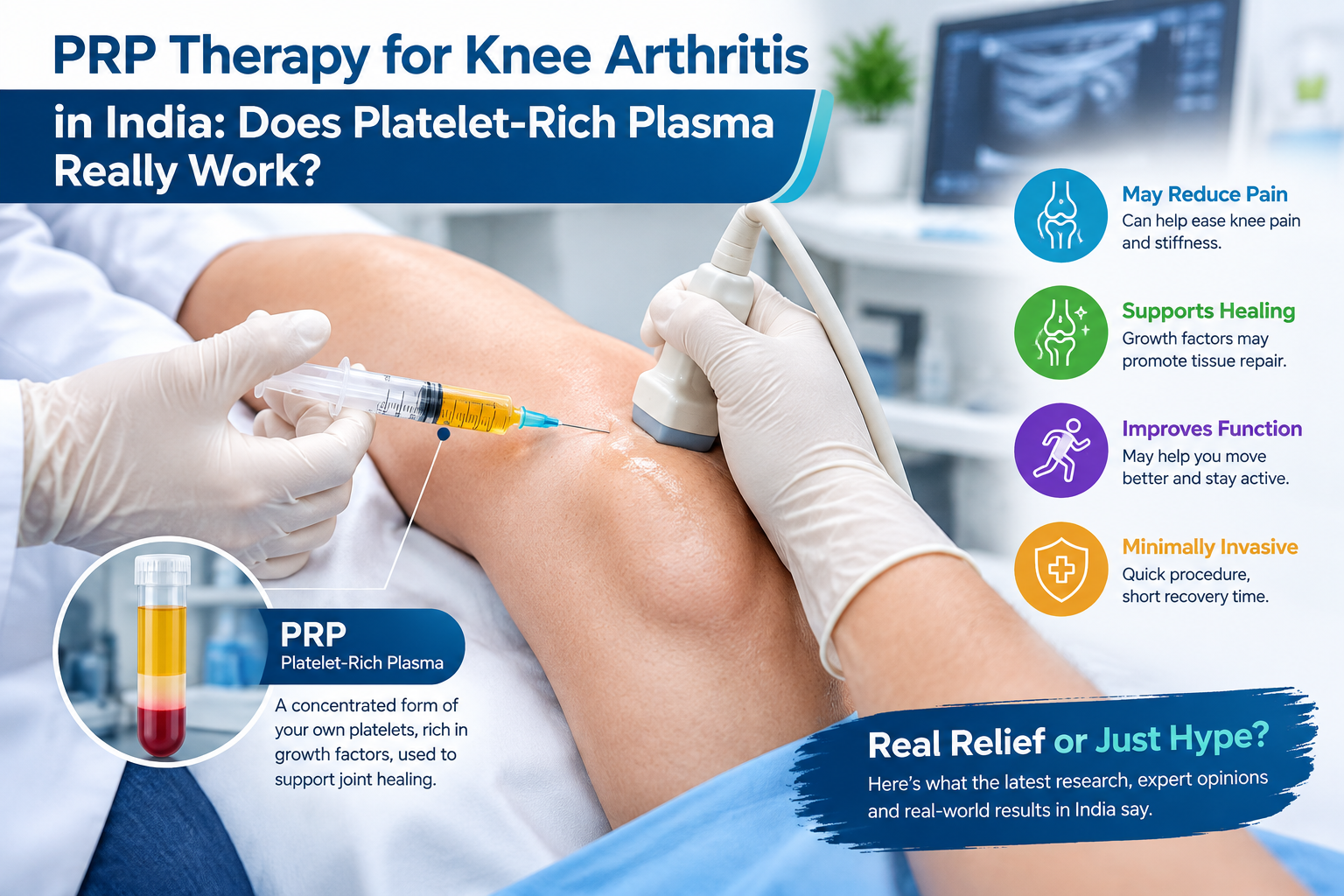
PRP therapy injection for knee arthritis showing platelet-rich plasma treatment for knee pain in Surat
Understanding the treatment

What Is PRP Therapy and How Does It Work?

PRP therapy is a regenerative injection treatment that uses growth factors from the patient's own blood to reduce joint inflammation and stimulate cartilage repair. Critically, it is autologous — entirely derived from your own blood — eliminating the risk of allergic reaction or rejection. At Shivaan Hospital, PRP is offered as part of comprehensive PRP therapy and joint injection care. For advanced arthritis, patients may also explore total knee replacement surgery. Here is the three-step process:

1
Blood Draw & Centrifugation
30–60 ml of blood drawn from the arm. Spun in a specialised centrifuge for 10–15 minutes to separate and concentrate platelets — cells rich in growth factors (PDGF, TGF-β, VEGF, IGF-1).
2
Preparation & Quality Check
The platelet-rich layer is carefully extracted. At Shivaan Hospital, a medical-grade centrifuge ensures consistent, high-concentration PRP — the quality of preparation directly affects treatment outcomes.
3
Precise Joint Injection
PRP injected into the knee joint under precise anatomical guidance. Growth factors reduce inflammatory cytokines, stimulate synovial fluid production, and promote chondrocyte (cartilage cell) activity over the following 2–6 weeks.
What the research shows

What Does the Evidence Say About PRP for Knee Arthritis?

The evidence for PRP in knee osteoarthritis has grown substantially. Here is an honest summary — including what PRP does well and where its limitations lie. Patients comparing non-surgical options with surgery can also review our guide on signs you need a knee replacement:

18
Randomised controlled trials in a 2021 meta-analysis showing PRP superior to HA at 12 months
60–75%
Of appropriate candidates experience meaningful pain relief — Grade 1–3 arthritis
12–18
Months of sustained pain relief in good responders — vs. 3–6 months for steroid injections
What PRP Does Well
Multiple randomised controlled trials show PRP provides significantly better pain relief and functional improvement than hyaluronic acid at 6 and 12 months. PRP consistently shows the most benefit in Grade 1–3 osteoarthritis. Younger patients (under 65) with active lifestyles respond better than older, sedentary patients. Pain relief lasting 12–18 months is reported in good responders — compared to 3–6 months for steroid injections.
What PRP Cannot Do
PRP cannot regenerate cartilage that has been completely destroyed — it is not a solution for Grade 4 (bone-on-bone) arthritis. It cannot replace knee replacement in patients who truly need surgery. Response rates vary — approximately 25–40% of patients have minimal improvement. PRP is not a permanent cure — most patients require repeat courses every 12–18 months for sustained benefit.
The Honest Truth About PRP
PRP is not a miracle cure and not a substitute for surgery in end-stage arthritis. It is a genuinely effective non-surgical option for the right patients — providing meaningful pain relief, delaying surgery, and improving quality of life. Choosing PRP requires an accurate arthritis grade diagnosis and an honest conversation about realistic expectations.
How PRP compares

PRP vs. Steroid vs. Hyaluronic Acid: Complete Comparison

Patients in Surat are commonly offered steroid or hyaluronic acid injections before PRP is even discussed. Here is how all three compare across every factor that matters:

Feature PRP Therapy 💉 Steroid Injection ⚡ Hyaluronic Acid 💧
How it worksGrowth factors stimulate cartilage repair & reduce inflammationPowerful anti-inflammatory — suppresses pain signals rapidlyLubricates joint; may mildly reduce inflammation
Pain relief onset2–6 weeks — gradual improvement24–72 hours — rapid, dramatic relief2–4 weeks — gradual improvement
Duration of relief12–18 months in good responders3–6 months maximum3–6 months typical
Effect on cartilagePotentially regenerative — may slow cartilage loss⚠ Potentially harmful — repeated use damages cartilageNeutral to mildly protective — not regenerative
Safe for diabetics✓ Yes — own blood, no blood sugar effect✗ No — causes significant glucose elevation in diabetics✓ Yes — no systemic effect
Max injections / year1–3 per course; repeat at 12–18 months3–4 maximum — more causes harm3–5 injections per course
Best candidateGrade 1–3 arthritis; active patients; diabeticsAcute flare; severe pain; any grade — short-termGrade 2–3 arthritis; older patients
Approx. cost in Surat₹8,000–₹20,000 per session₹500–₹2,000 per injection₹5,000–₹15,000 per course
Risk of harmVery low — autologous (own blood)Moderate — repeated use causes cartilage damageLow — but limited duration for cost
⚠ Why Repeated Steroid Injections Are Dangerous
Corticosteroid injections provide fast pain relief — but repeated use causes progressive cartilage damage, accelerates joint space narrowing, and weakens periarticular bone. Current guidelines recommend a maximum of 3–4 steroid injections per year in a single joint. Patients with Grade 2+ arthritis should discuss PRP or hyaluronic acid as a safer long-term alternative.
Is PRP right for you?

Who Benefits Most From PRP Therapy for Knee Arthritis?

PRP candidacy is determined by arthritis grade, activity level, and prior treatment history. Here is the clinical decision guide used at Shivaan Hospital:

Grade 1–2 knee arthritis (mild-moderate)
✓ Excellent
Maximum regenerative potential when cartilage damage is still limited
Grade 3 arthritis (moderate-severe)
✓ Good
Pain reduction and meaningful delay of TKR — most common candidate in Surat clinics
Grade 4 arthritis (bone-on-bone)
✗ Poor
Insufficient cartilage remaining for meaningful regeneration — TKR consultation advised instead
Active patient wanting to delay surgery 1–3 years
✓ Excellent
PRP buys meaningful pain-free time while optimising weight and fitness for eventual surgery
Diabetic patient with knee arthritis
✓ Good
PRP is significantly safer than repeated steroids — which worsen blood sugar control in diabetics
Patient who failed steroid injections
✓ Good
PRP works through a different mechanism — steroid failure does not predict PRP failure
Post-surgical joint (after TKR / THR)
✗ Not indicated
PRP is for natural cartilage only — not indicated for joints that have already been replaced
What to expect at Shivaan Hospital

The PRP Procedure — Before, During, and After

The full PRP experience at Shivaan Hospital takes approximately 45–60 minutes and is performed as a same-day procedure with no hospital admission required:

1
Before the Procedure — Preparation
Stop NSAIDs (ibuprofen, diclofenac, naproxen) 5–7 days before — they inhibit platelet function and reduce PRP effectiveness. Avoid steroid medication for 2 weeks prior. Eat normally on the day of the procedure. No anaesthesia or fasting required.
2
During — Blood Draw, Preparation, and Injection
Blood drawn from the arm (same as a standard blood test). Centrifuged for 10–15 minutes to concentrate platelets. The knee is cleaned under sterile conditions and PRP injected precisely into the joint. The injection itself takes under 2 minutes. Total procedure time: 45–60 minutes.
3
After — Recovery and Expectations
Expect 2–5 days of increased soreness and mild swelling — this is the expected inflammatory phase before regenerative response begins. Avoid NSAIDs for 2 weeks post-injection (use paracetamol if needed). Avoid high-impact sport for 2 weeks. Most patients begin noticing improvement between Weeks 2–6.
4
Treatment Course — Number of Sessions
Most patients receive 1–3 injections per course, spaced 4 weeks apart. Grade 1–2 arthritis often responds to a single injection. Grade 3 typically benefits from 2–3 injections. A repeat course at 12–18 months maintains sustained benefit. Total session requirements are discussed and written in your treatment plan at the first consultation.
Why Surat patients choose Shivaan

Why Choose Shivaan Hospital for PRP Therapy?

PRP at Shivaan Hospital is not a walk-in injection clinic service. It is administered by an orthopaedic fellowship specialist with full arthritis assessment, imaging review, and integrated management — not just an injection and farewell.

Ultrasound-Guided Injection
Imaging-guided injection ensures PRP is delivered precisely into the joint space — not periarticular tissue. Accuracy significantly affects outcomes.
Medical-Grade Centrifugation
The concentration and quality of platelet preparation directly affects treatment response. Shivaan uses hospital-grade systems — not clinic-grade desktop devices.
Fellowship-Specialist Oversight
Dr. Donda assesses PRP candidacy, monitors response, and integrates injection therapy with physiotherapy and surgical planning — not a standalone procedure.
Diabetic Patient Expertise
PRP is the specifically appropriate injection for diabetics who cannot tolerate steroid-induced glucose elevations. Dr. Donda's team manages both conditions simultaneously.
Integrated Arthritis Management
PRP is combined with physiotherapy, weight management, and clear surgical planning — so you know exactly where PRP fits in your long-term arthritis journey.
Transparent Written Treatment Plan
Number of sessions, session costs, expected outcomes, and when to reassess — all in writing before treatment begins. No surprises, no hidden charges.
Is PRP right for your knee?

Signs You Should Consider PRP Therapy for Your Knee

If any of the following apply, book a PRP candidacy consultation — earlier assessment means more regenerative potential and a wider range of non-surgical options:

Knee arthritis (Grade 1–3) causing persistent pain during or after daily activity
You have had steroid injections providing only short-term relief or worsening benefit each time
You are a diabetic patient whose blood sugar worsens significantly after steroid injections
You are an active patient who wants to delay knee replacement surgery for 1–3 years
Physiotherapy alone is not providing adequate pain control between sessions
You want to try a non-surgical option before committing to a major knee replacement operation
Everything you need to know

Frequently Asked Questions

Questions grouped by category — tap any question to expand the answer.

Treatment Results
How long does a PRP injection last for knee arthritis?
In good responders, PRP provides meaningful pain relief for 12–18 months — significantly longer than corticosteroid injections (3–6 months) and comparable to or better than hyaluronic acid. Repeat courses at 12–18 months maintain the benefit in most patients without increasing risk of joint damage.
Can PRP cure knee arthritis completely?
No — PRP cannot cure or permanently reverse arthritic changes. It reduces inflammation, may slow cartilage degradation, and provides meaningful pain relief for 12–18 months. It is best understood as a disease-modifying and symptom-managing treatment. Patients with Grade 4 arthritis generally need surgical consultation rather than PRP.
Can PRP help me avoid knee replacement surgery?
PRP can significantly delay knee replacement surgery in patients with Grade 1–3 arthritis — often by 1–3 years or more in good responders. It cannot prevent surgery indefinitely in progressive arthritis. Dr. Donda discusses PRP as part of a comprehensive surgical planning conversation — including at what point surgery would provide better outcomes than continued injection therapy.
Is PRP better than steroid injection for knee pain?
For sustained benefit, yes. PRP provides pain relief lasting 12–18 months compared to 3–6 months for steroids — and does not damage cartilage with repeated use. For immediate relief of an acute inflammatory flare, steroids work faster. PRP and steroids work through different mechanisms and are appropriate for different clinical situations.
Procedure & Recovery
Is PRP therapy painful?
The blood draw is the same as a standard blood test. The injection itself causes brief discomfort — most patients describe it as similar to a steroid injection. Post-injection soreness for 2–5 days is expected and indicates the treatment is working. Topical anaesthetic cream can reduce injection discomfort if needed.
How many PRP injections do I need?
Most patients receive 1–3 injections per treatment course, spaced 3–4 weeks apart. Grade 1–2 arthritis often responds to a single injection. Grade 3 arthritis typically benefits from 2–3 injections. The total number is discussed at your initial consultation based on your X-ray and MRI findings — and confirmed in a written treatment plan.
How soon will I feel improvement after PRP injection?
Most patients begin noticing improvement between Weeks 2–6 after the injection. Unlike steroids, PRP works through a biological growth factor response that takes weeks to manifest. Patients who feel no improvement by Week 8 should have a clinical review to assess whether a second injection or alternative management is indicated.
Safety & Cost
Can diabetic patients have PRP injections?
Yes — PRP is particularly appropriate for diabetic patients. It is derived from the patient's own blood, carries no blood sugar effects, and avoids the significant glucose elevation that corticosteroid injections cause in diabetics. Dr. Donda specifically recommends PRP over steroid injections for diabetic patients with knee arthritis whenever possible.
What is the cost of PRP therapy in Surat?
At Shivaan Hospital, PRP injection costs range from ₹8,000–₹20,000 per session depending on the concentration method and number of sessions required. A written treatment plan with all session costs is provided before any commitment. No hidden charges — total cost and number of sessions confirmed upfront.
How do I book a PRP consultation at Shivaan Hospital?
Call or WhatsApp +91 98790-99184, visit Infinity Tower, Lal Darwaja Station Road, Surat, or book at shivaanhospital.com. Bring your knee X-rays and MRI reports. Dr. Donda reviews arthritis grade and confirms PRP candidacy at the first appointment — with a written treatment plan provided the same day.
Day 1
Consultation & Grade Assessment
Day 7–14
PRP Injection (Session 1)
Week 2–6
Pain Improvement Begins
Months 12–18
Repeat Course if Needed
Book your PRP consultation

Is PRP Right for Your Knee? Find Out at Shivaan Hospital.

Book a PRP candidacy consultation with Dr. Krunal Donda at Shivaan Hospital, Surat. Get your arthritis grade assessed, receive an honest comparison of all injection options, and a written treatment plan — before committing to any procedure.

Call / WhatsApp
+91 98790-99184
Location
Infinity Tower, Lal Darwaja Station Road, Surat
Website
shivaanhospital.com

Leave a Comment

Your email address will not be published. Required fields are marked *

Scroll to Top